

Inspect Element To Find Answers
At that place's a powerful tool hiding in your browser: Inspect Chemical element.
Correct-click on any webpage, click Audit, and you lot'll see the innards of that site: its source code, the images and CSS that form its pattern, the fonts and icons information technology uses, the Javascript code that powers animations, and more. You can see how long the site takes to load, how much bandwidth information technology used to download, and the exact colour in its text.
Or, you could use it to change anything you want on the folio.
Inspect Chemical element is a perfect way to learn what makes the web tick, figure out what's broken on your sites, mock up what a color and font change would wait like, and proceed yourself from having to Photoshop out private details in screenshots. It's a super-ability yous never knew your browser possessed.
Allow'due south larn how to use Google Chrome Inspect Element to help your work, whether you're a programmer or a marketer who'due south never written a line of lawmaking. If you're reading this on your phone, it'due south time to switch over to your laptop, open Google Chrome, and get ready to tweak some lawmaking.
Most web browsers—including Mozilla Firefox and Apple tree'due south Safari—include an Inspect Chemical element tool, while Microsoft's Net Explorer and Border browser include a like set of Programmer Tools. This tutorial focuses on Google Chrome'due south Audit Element tools, but near of the features piece of work the same in other browsers.
Wait, Why Should I Use Inspect Element?
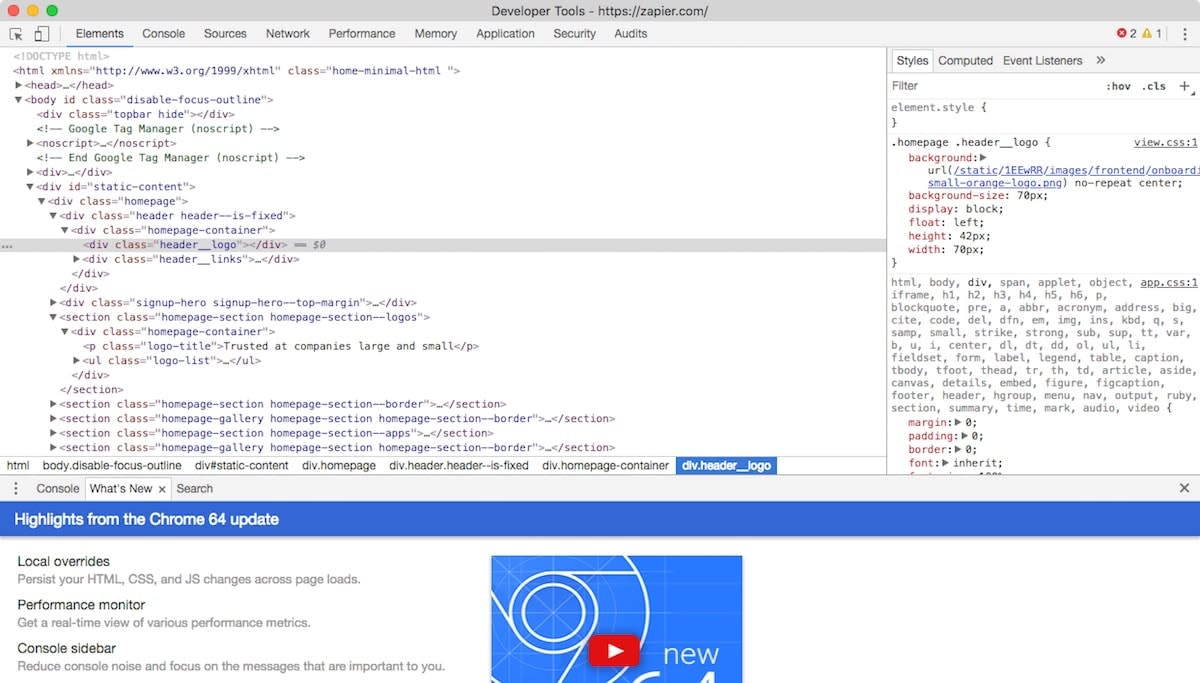
If you've never peeked at a website'south lawmaking out of curiosity, you might wonder why you should learn how to use Inspect Chemical element.
-
Designer: Desire to preview how a site pattern would look on mobile? Or desire to see how a different shade of green would expect on a signup button? Yous tin can exercise both in seconds with Inspect Element.
-
Marketer: Curious what keywords competitors apply in their site headers, or desire to see if your site's loading too slow for Google'southward PageSpeed test? Inspect Element tin show both.
-
Writer: Tired of blurring out your proper noun and email in screenshots? With Audit Element, you can change any text on a webpage in a second.
-
Support Agent: Demand a better way to tell developers what needs fixed on a site? Audit Element lets you make a quick example change to show what you lot're talking about.
Never miss a Zapier web log postal service
For these and dozens of other use cases, Inspect Element is a handy tool to keep around. It'south part of the Programmer Tools in your browser, which includes a number of extra features: a panel to run lawmaking, a View Source page to see just the raw code behind a site, a Sources page with a list of every file loaded in a website, and more. You can explore all those on your own, but for now, let's see how to use the main Elements tab to tweak a webpage on our own.
How to Get Started with Audit Chemical element
At that place are a few ways to access Google Chrome Audit Element. Just open a website yous want to try editing (to follow along with this tutorial, open Zapier.com), then open the Inspect Chemical element tools in one of these iii ways:
-
Correct-click anywhere on the webpage, and at the very bottom of the menu that pops up, you volition run across "Inspect." Click that.
-
Click the hamburger menu (the icon with 3 stacked dots) on the far correct of your Google Chrome toolbar, click More Tools, then select Developer Tools. Alternately, in the file menu, click View —> Developer —> Programmer Tools.
-
Prefer keyboard shortcuts? Press
CMD+Option+Ion a Mac, orF12on a PC to open up Inspect Elements without clicking anything.
By default, the Developer Tools open up in a pane at the very lesser of your browser and volition show the Elements tab—that's the famed Inspect Element tool we've been looking for.
Yous won't have much space to work with Inspect Element at the lesser of your screen, then click the iii vertical dots on the top right-hand side of the audit element pane most the "X" (which y'all'd click to close the pane). Now, you'll see an selection to motility the pane to the right-hand side of your browser (right-dock view) or to open the pane in a completely separate window (undock view).
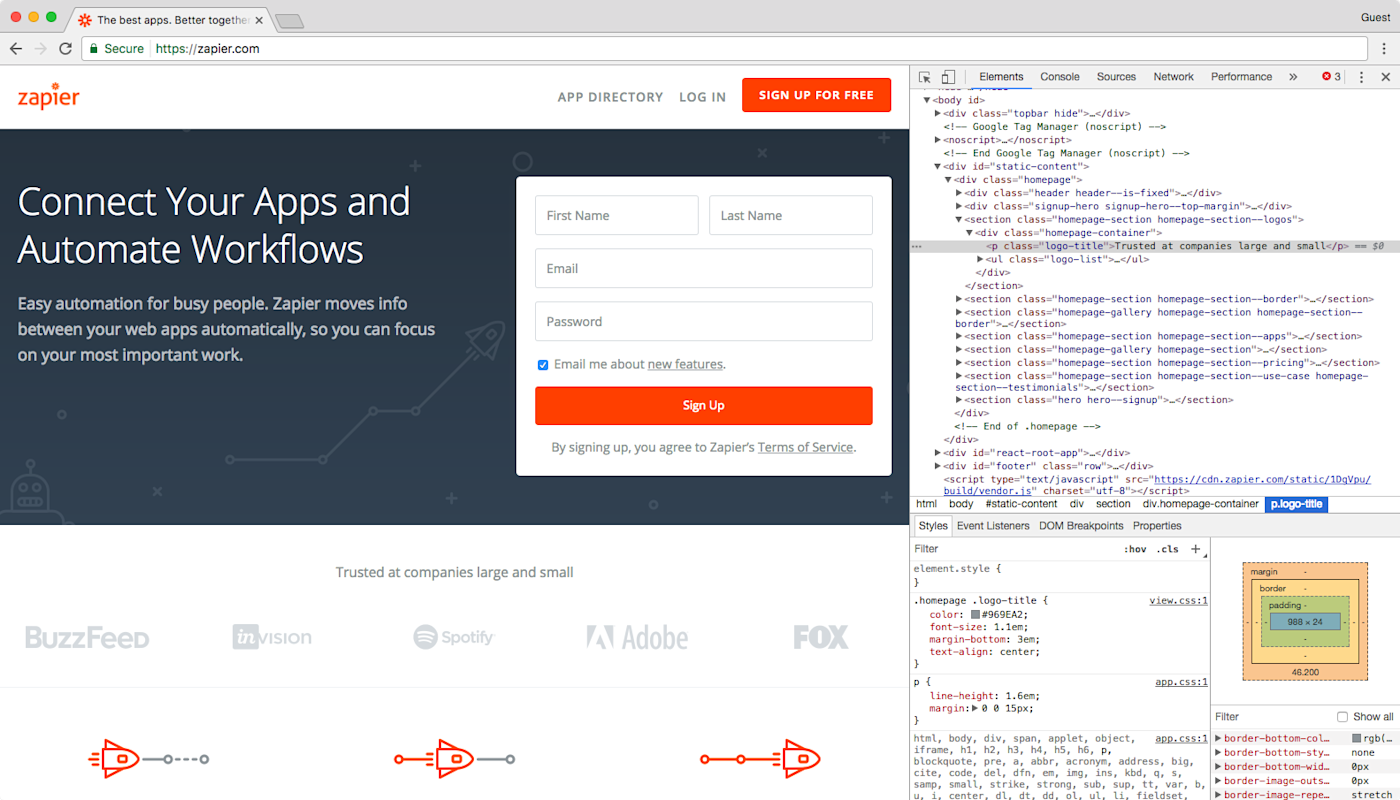
For this tutorial, permit's dock the pane on the right side of your browser window to give the states more space to work. You can brand the Developer Tools panel wider or more narrow by hovering over the left-side border. In one case the ↔ cursor appears, drag the pane left to widen it or right narrow it.
Now that we're in Inspect Element, in that location an array of useful tools at our fingertips that we tin use to make any site look exactly how nosotros want. For this tutorial, we volition focus on the Elements, Emulation, and Search tabs.
Search
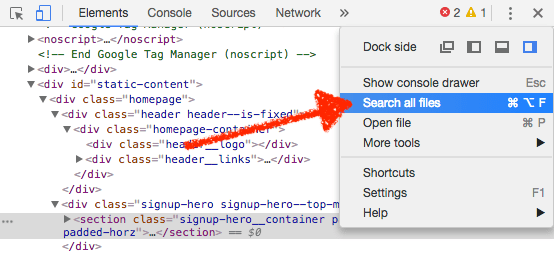
The "Search" tab allows you to search a spider web page for specific content or an HTML element. It's a bit hidden: you'll need to click the iii dots and so click Search All Files to uncover it. And so you'll be able to search through every file in a webpage for anything you want.
Elements
"Inspect Element" is the tool we will explore about in this tutorial, and it's what opens first when y'all launch the Developer Tools in most browsers. Or, click the "Elements" tab in the Developer Tools to become back to it if you've been exploring elsewhere.
In the Explore tab, you lot tin see all of the HTML, JavaScript, and CSS that congenital a website. It'due south almost the same equally just viewing the source of a website, with one crucial difference: you can change any of the lawmaking, and run across the changes in real-fourth dimension on the site you lot have open up. You can change anything from the copy to the typeface, then screenshot the new pattern or salvage your changes (just go to View > Developer > View Source and save the page as an HTML file, or copy the code changes to your text editor). Once you re-load the folio, though, all of your changes volition be gone forever.
Emulation
Ever wanted to preview a webpage on a phone without pulling your phone out of your pocket? The "Emulation" tab lets you view a web page as information technology would look on any device, with presets for popular devices or an option to set screen resolution and attribute ratio. You lot can even set an emulated net speed, to see how rapidly a site would load over dial-upwardly.
It's too a bit hidden: you'll demand to open Inspect Chemical element and click the phone icon button to start it. Then, you'll have a perfect tool to understand how others feel a webpage.
It's fourth dimension to get to work. We'll first use Search to find things on a webpage, so employ Elements to edit text and more on a site, and finally will utilise Emulation to see how our site would look on a telephone from a specific location.
Find Annihilation on a Site With Inspect Element Search
Wondering what goes into your favorite sites? Search is your all-time tool for that, aside from reading a site's entire source code. You could simply open the default Elements view, press CTRL+F or CMD+F and search through the source code, but the full Search tool will let y'all search through every file on a page, helping you lot detect text inside CSS and JavaScript files or locate an icon image y'all need for an article.
To become started, open Zapier.com in Chrome if yous haven't already, so open Audit Element, click the three vertical dots in the top-correct corner of the Developer Tools pane (about the endmost "X"), and select "Search All Files." The Search tab will appear on the bottom half of the Programmer Tools pane.
Retrieve how to open Inspect Element? Only right-click and click Inspect Inspect Chemical element, or press Command+Choice+i on your Mac or F12 on your PC.
In the search field, you can blazon anything—Annihilation—that you desire to find on this spider web page, and it will appear in this pane. Let's meet how we tin can use this.
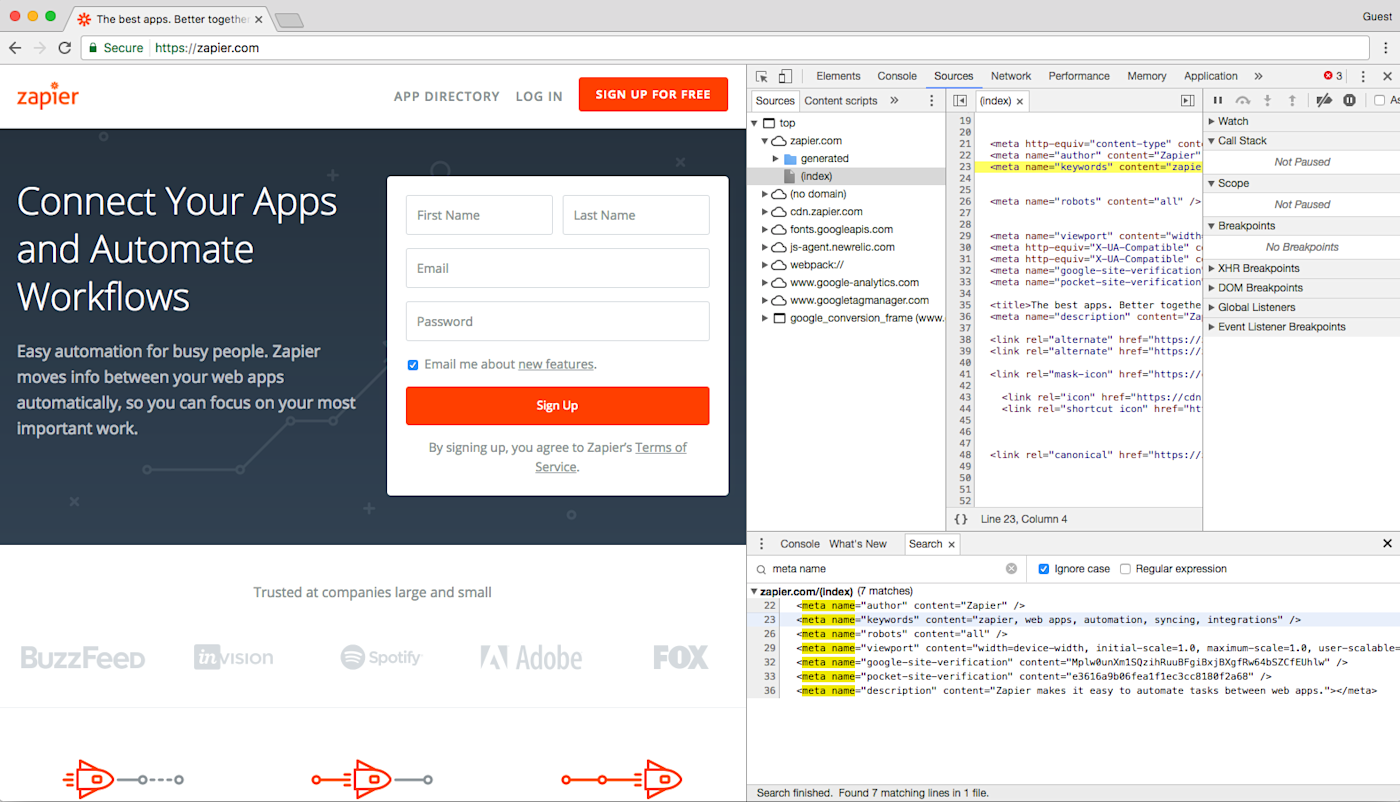
Type meta name into the search field, printing your Enter key, and yous'll immediately see every occurrence of "meta proper noun" in the code on this page. Now, y'all can see this page's metadata, the SEO keywords its targeting, and whether or not it'south configured to permit Google index it for search. That'southward an easy way to see what your competitors are targeting—and to brand sure you lot didn't mess anything upwards on your site.
Let's try another query. Delete meta name, type h2 into the search field instead, and press "enter." You'll see every occurrence of "h2" in Zapier's JavaScript files at the top, but in one case yous curlicue to the bottom, you can see every "h2" header on this page.
Search is an constructive tool for designers as well since yous tin can search by colour, too. Type #ff4a00 into the search field and press "enter" (and brand sure to cheque the box beside "Ignore case" to see all of the results). You lot should now meet every time the colour #ff4a00, Zapier's shade of orange, in this site'south CSS and HTML files. Then, just click the line that reads "color: #ff4a00;" to jump to that line in the site'due south HTML and tweak information technology on your own (something we'll look at in the next section).
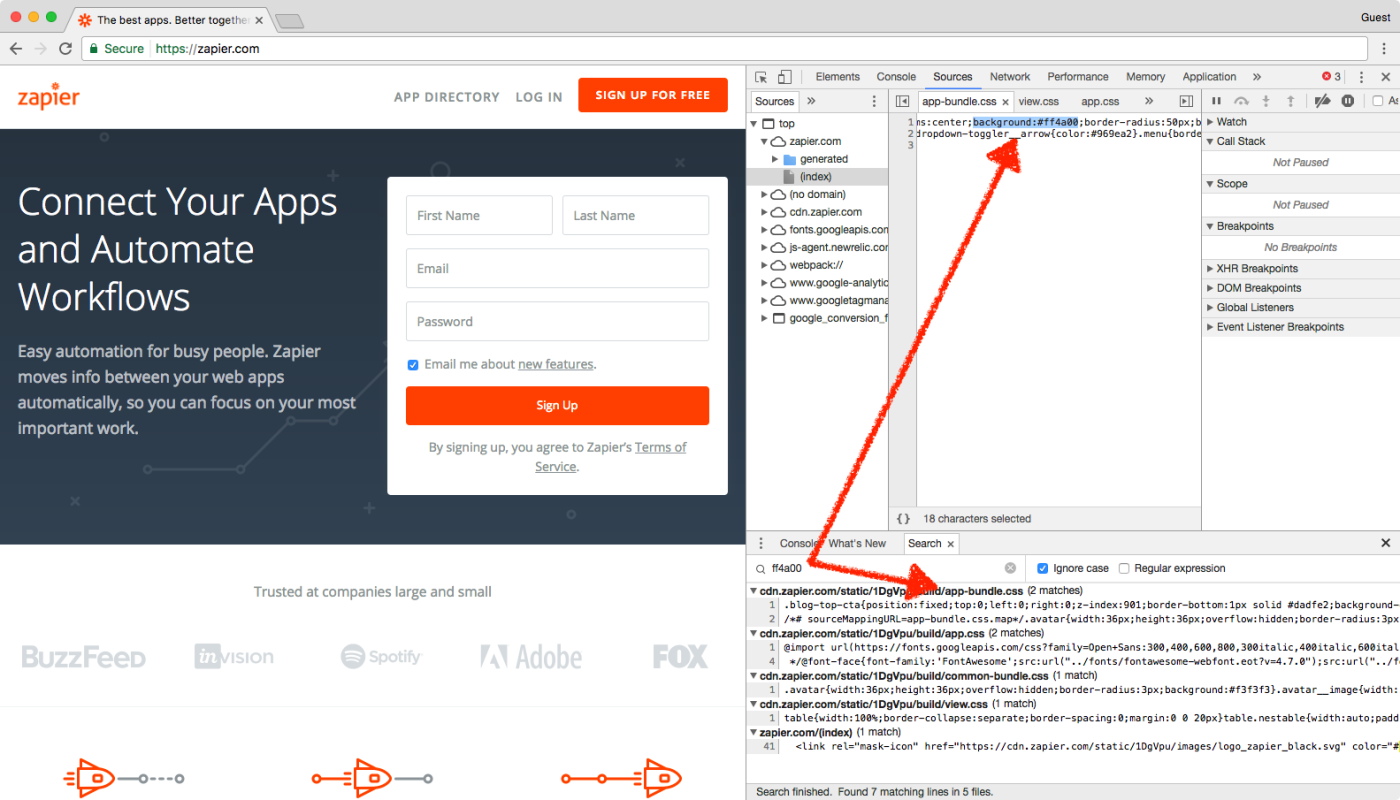
This is a handy way for designers to make sure that a site is post-obit their brand'due south mode guide. With the "Search" tool, designers can easily bank check the CSS of a web folio to see if a colour is practical to the wrong element, if an wrong font-family unit is used on a web folio, or if you lot're however using your old colour somewhere on your site.
The "Search" tool is too the perfect fashion to communicate with developers better since you lot tin can bear witness them exactly where you've found a mistake or exactly what needs changing. Only tell them the line number where the problem exists, and y'all'll get your ready that much quicker.
Or, y'all tin alter the web folio yourself with the Elements, the core part of Chrome'due south Developer Tools.
Change Anything with Elements
Forepart-end developers employ the Inspect Element tool every twenty-four hour period to change the appearance of a web page and experiment with new ideas—and you lot tin can, too. Inspect Elements lets you tweak the advent and content of a web page, by adding temporary edits to the site'due south CSS and HTML files.
Once you close or reload the page, your changes will be gone; you'll only come across the changes on your calculator and aren't actually editing the real website itself. That way, you tin feel gratis to experiment and modify anything—and so copy and save the very best changes to use again afterward.
Let's encounter what we tin can do with it.
Click the "Elements" tab in the Programmer Tools pane—and if y'all want more than room, tap your "Esc" key to close the search box you had open before. You should run across the HTML for this page—at present you lot know how the sausage gets made.
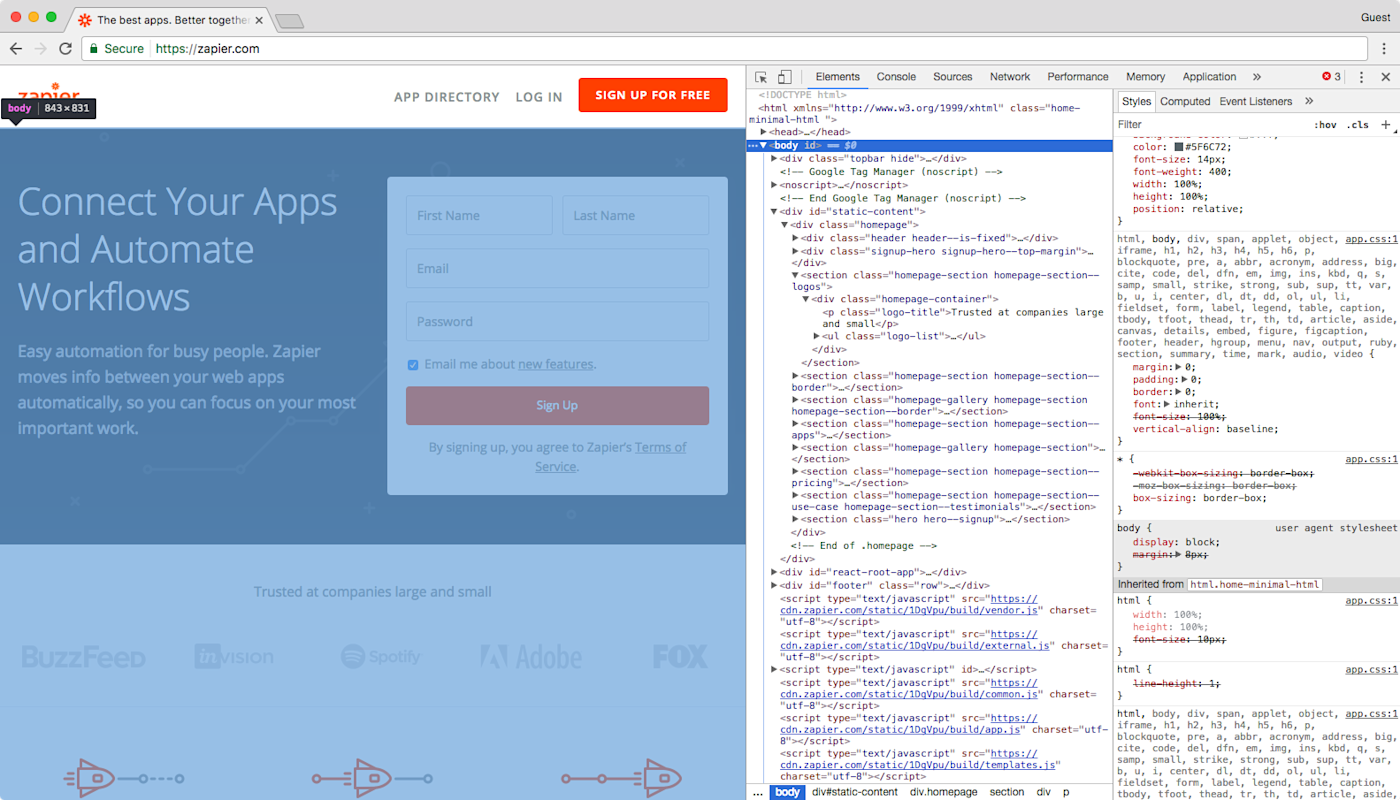
In the top-left corner of the developer pane, yous will see an icon of a mouse on meridian of a square. Click information technology, then you can select any element on the page that you would like to change. So let'southward change some things!
Change the Text on a Webpage
E'er wanted to change text on a site—perhaps to meet how a new tagline would look on your homepage, or to take your e-mail address off of a Gmail screenshot? Now you lot can.
Click the "mouse on top of a square" icon, then click whatsoever text on the page—perchance the tagline on the Zapier homepage. In your Developer Tools pane, yous will come across a line of text with a bluish highlight that looks something like this:
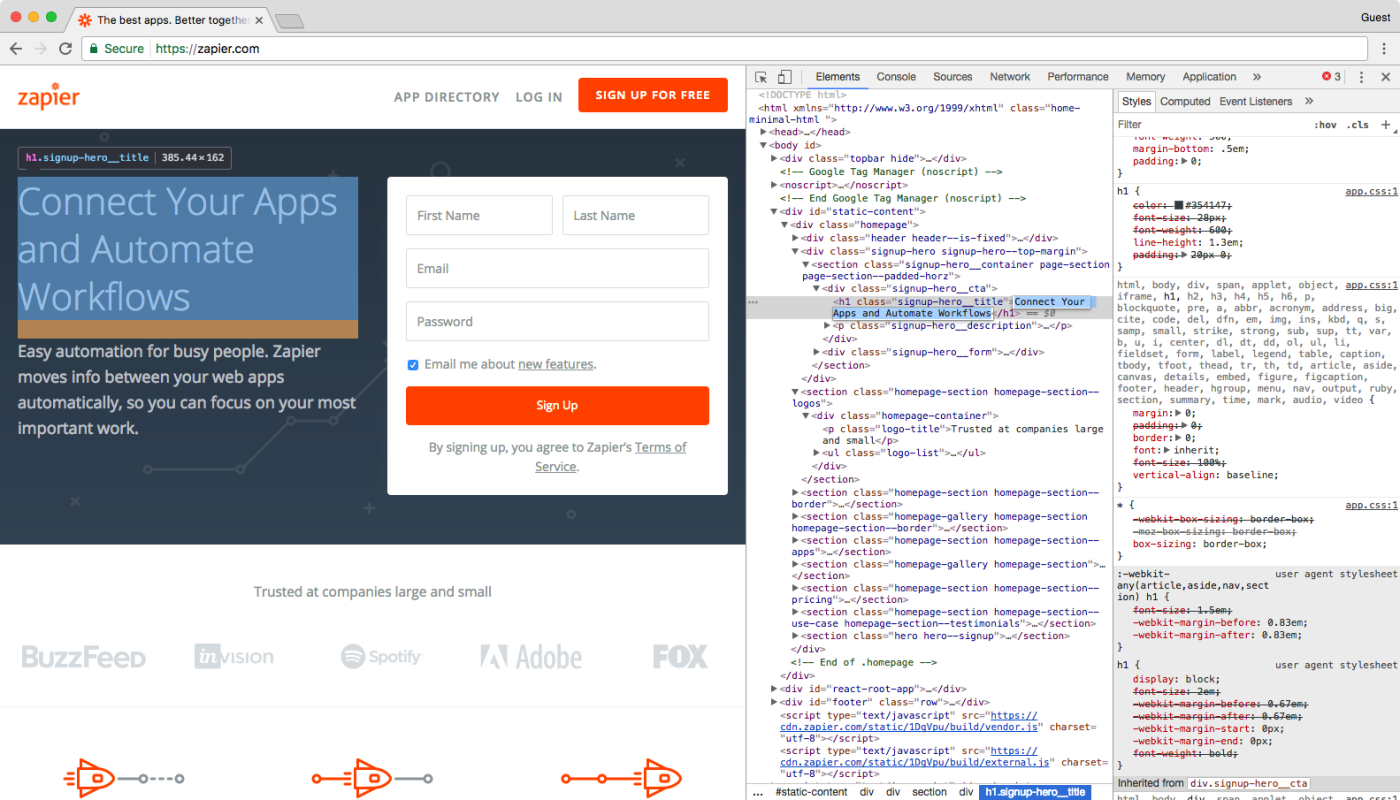
Double-click the "Connect Your Apps" text that's highlighted blue in the Programmer Tools pane, and it will plow into an editable text field.
Type anything yous like in this text field ("Auri is a genius" should work just fine), and press enter. Voila! You've just inverse the text on the web page.
Refresh the folio, and everything will go back to normal.
Fun? Let'southward alter some more things on this folio.
Your Programmer Tools pane re-loads with the page, but let's close it. Printing the "Ten" in the top-correct corner of the page.
Cool. Now we're going open up information technology back up—right at the text nosotros want to edit. All you have to do is correct-click on the part of the page you want to change, then click the Audit or Audit Chemical element link that appears on the bottom of the right-click menu.
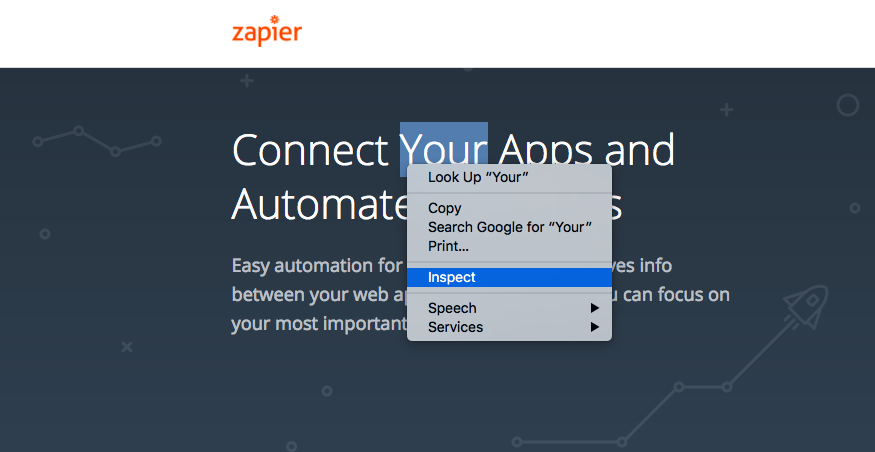
When your Developer Tools pane opens, it should automatically highlight that sentence. Pretty cracking, huh? Information technology'south the little things that count.
At present that we've selected the tagline on the Zapier site let'due south change how it looks.
Change the Color and Font of Elements
To the right of this judgement in the Developer Tools pane, y'all will encounter a sub-pane with 3 additional tabs: Styles, Computed, and Event Listeners. Each allows you to change how this sentence looks on the page. Allow'southward become started on "Styles" tab.
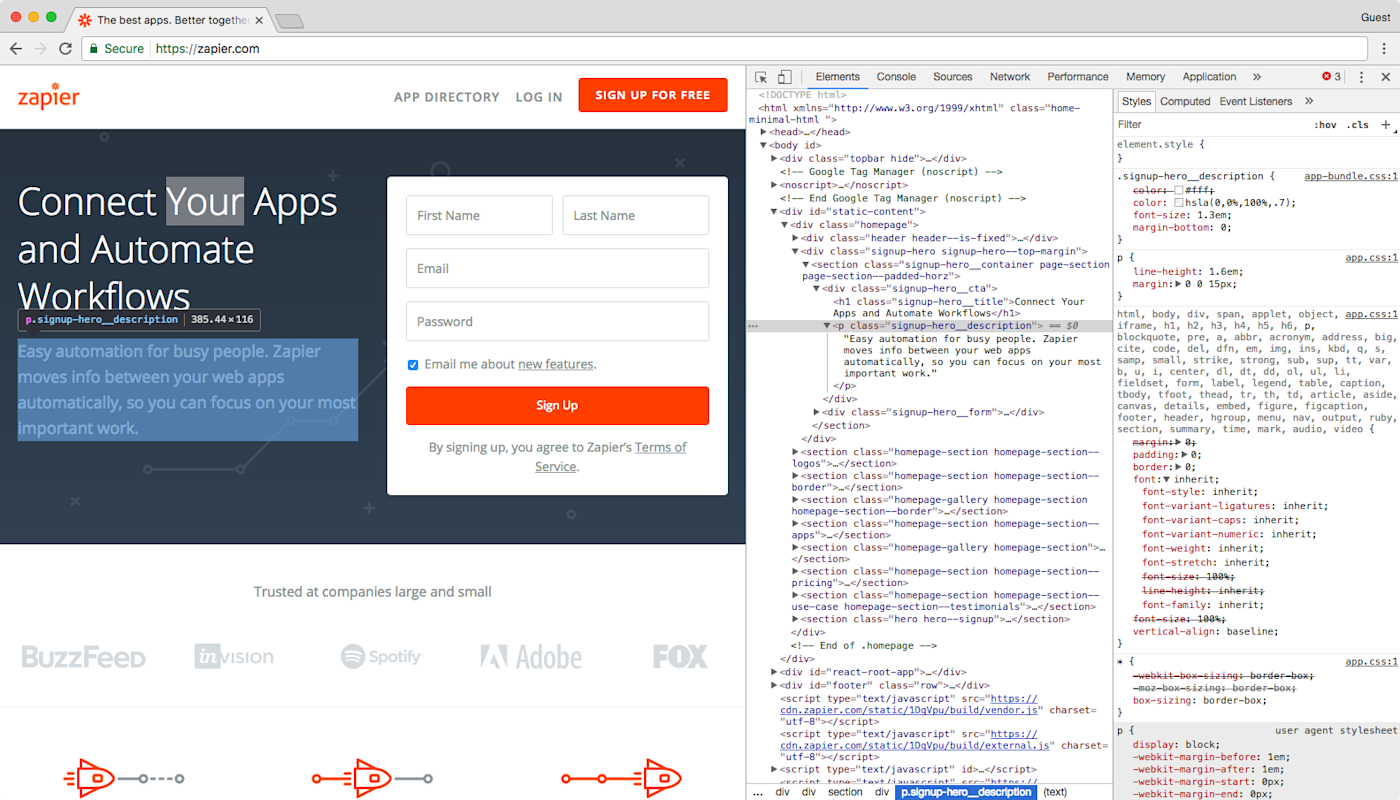
You may find that some things are crossed out in the "Styles" tab. This means that these styles are not agile for the element we've selected them, and so changing these values will have no effect. We tin can ignore these for our purposes.
Allow's effort changing something. Click the pointer icon in the top of Inspect Element again, and select the text right under the "Sign Upward" push on the page. Find "text-align" in the "Styles" tab (you may have to scroll a bit to find this).
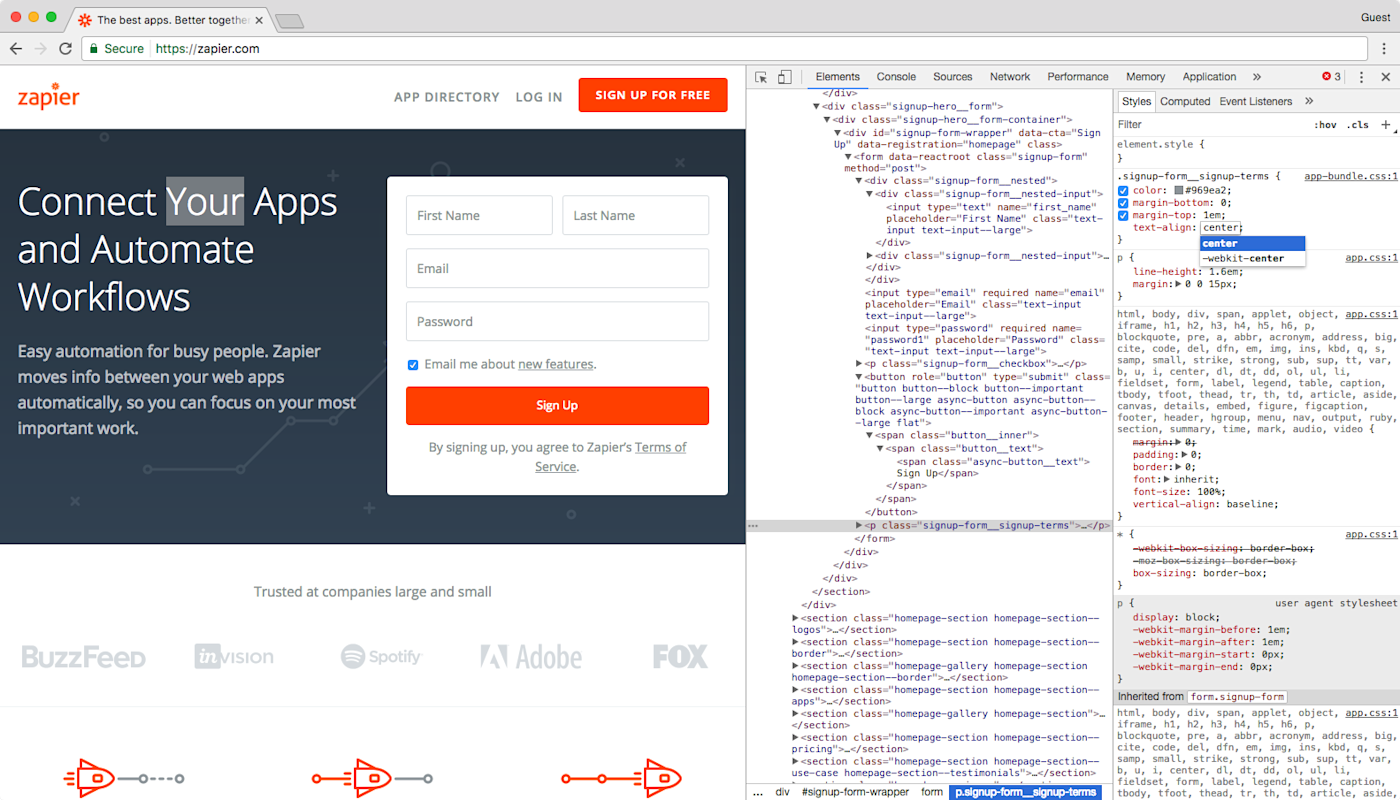
Right now, it is set to "center," but double-click "centre" and blazon left. This makes the text left-aligned on the page.
At present let'south play around with the color. Utilise the mouse icon in Audit Chemical element to select the push this time, then in the Styles tab find this line:
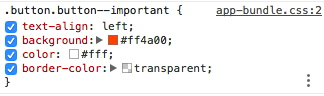
And double-click "#ff4a00". Type #4199ad (do non forget the #) and printing "enter."
We simply changed the colour of our button from orange to blue! At present let's endeavor something actually cool.
Modify Chemical element States
Desire to see how a button or link volition await one time someone hovers over or clicks it? Chrome Inspect Element tin prove that too with its force element state tools. You can run across how the element volition look once a visitor hovers over the chemical element (hover state), selects the element (focus state), and/or has clicked that link (visited state).
Let's try this out. Make sure you've selected the signup push on the Zapier home page. Then, correct-click on that lawmaking in the Elements tab, and select :active: in that menu.
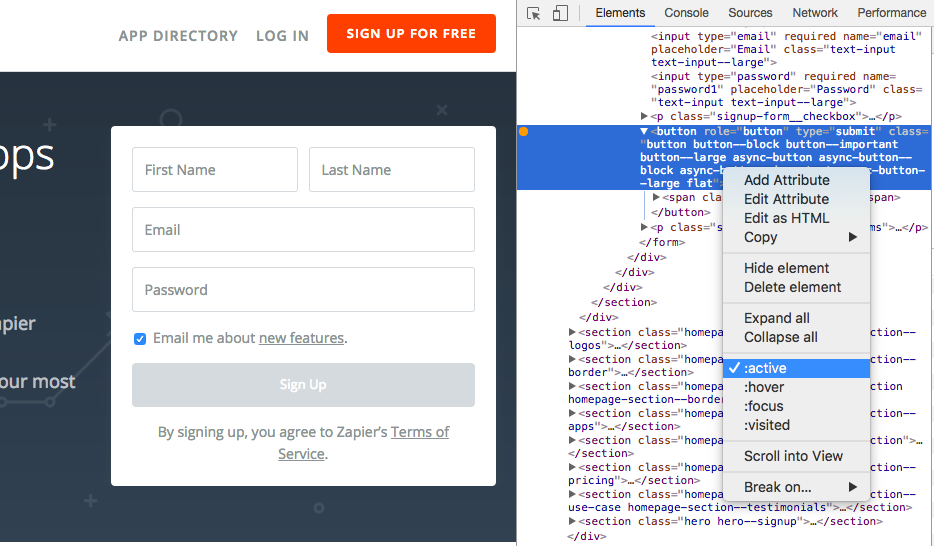
That will change the button to grey, which Zapier's site shows as you click the button.
At present change the background-color value to #FF4A00, and you should instantly see the button color change.
Endeavor experimenting—change the :hover: color, then united nations-check :hover: in the right-click card and drag your mouse over the push to run across the new push button colour.
Change Images
You can easily change images on a spider web page with Inspect Element, too. Let's swap the Superhero groundwork on the Zapier site with this dramatic photo of a solar flare from NASA.

Showtime, copy and paste this link to the image:
https://c1.staticflickr.com/9/8314/7931831962_7652860bae_b.jpg
At present, open Inspect Element on the groundwork of the Zapier homepage, and make certain you've selected the signup-hero line in the code. Double-click the background URL link in the "Styles" pane, and paste the link you copied above.
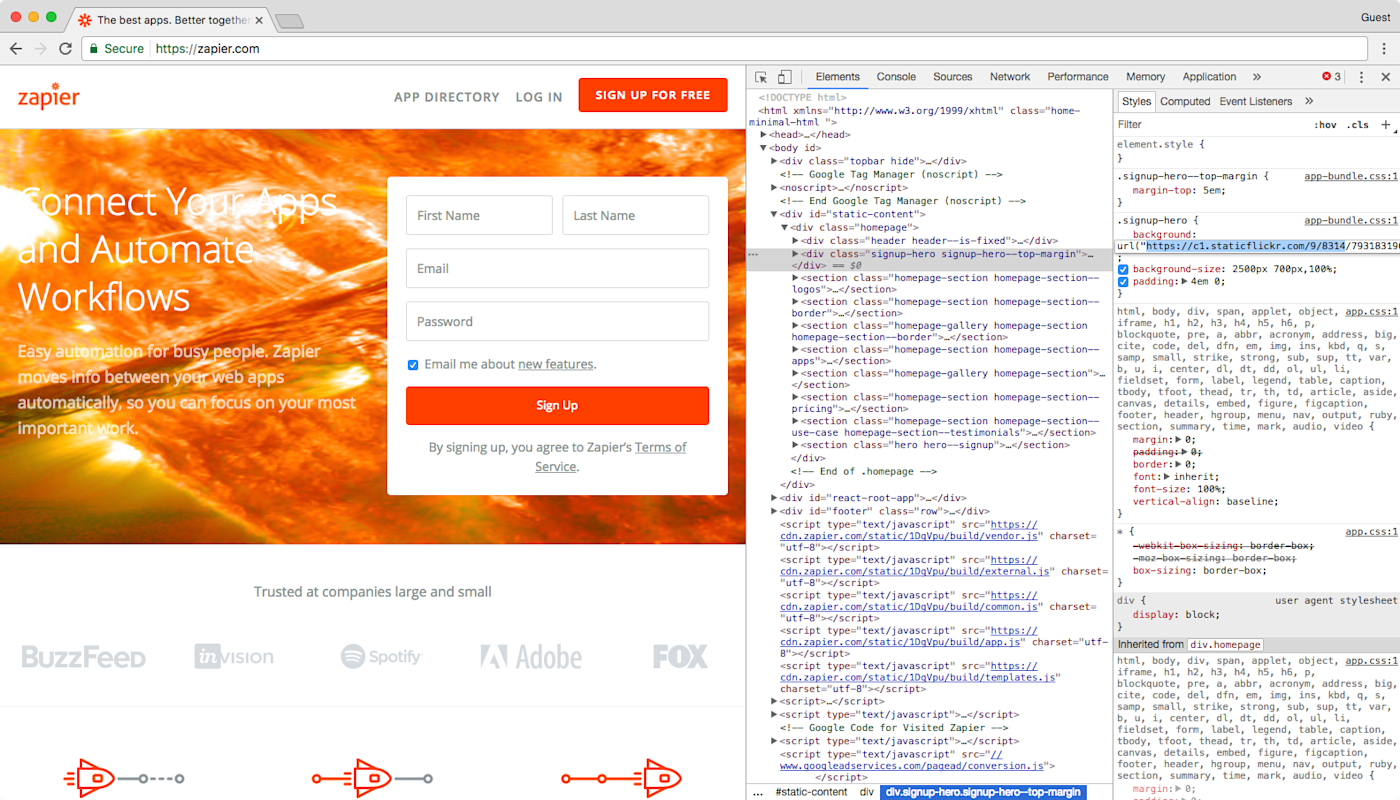
Press "enter" and encounter the difference immediately.
Notation: You lot tin can also modify a photo to a GIF or a video—all yous need is a link to the file, and you can add information technology in.
Editing text is handy, swapping out images is fun, and changing colors and styles simply might aid you rapidly mockup the changes you want made to your site. But how will that new tagline and button blueprint look on mobile?
That'southward where Emulation comes in—information technology'south where everything nosotros've reviewed and so far can be applied even farther. Let's see how.
Examination a Site on Any Device With Emulation
Everything has to be responsive today. Websites are no longer merely viewed on computers—they're more likely than ever to be viewed on a telephone, tablet, TV, or but almost whatsoever other blazon of screen. That should e'er exist kept in mind when creating new content and designs.
Emulation is a great tool to estimate how websites will wait to users across diverse devices, browsers, and fifty-fifty locations. Though this does not replace actually testing on a variety of devices and browsers, it's a nifty first.
In the Programmer Tools pane, you'll detect a footling phone icon in the top-left corner. Click it. This should modify the page into a tiny, telephone-styled page with a card at the top to modify the size.
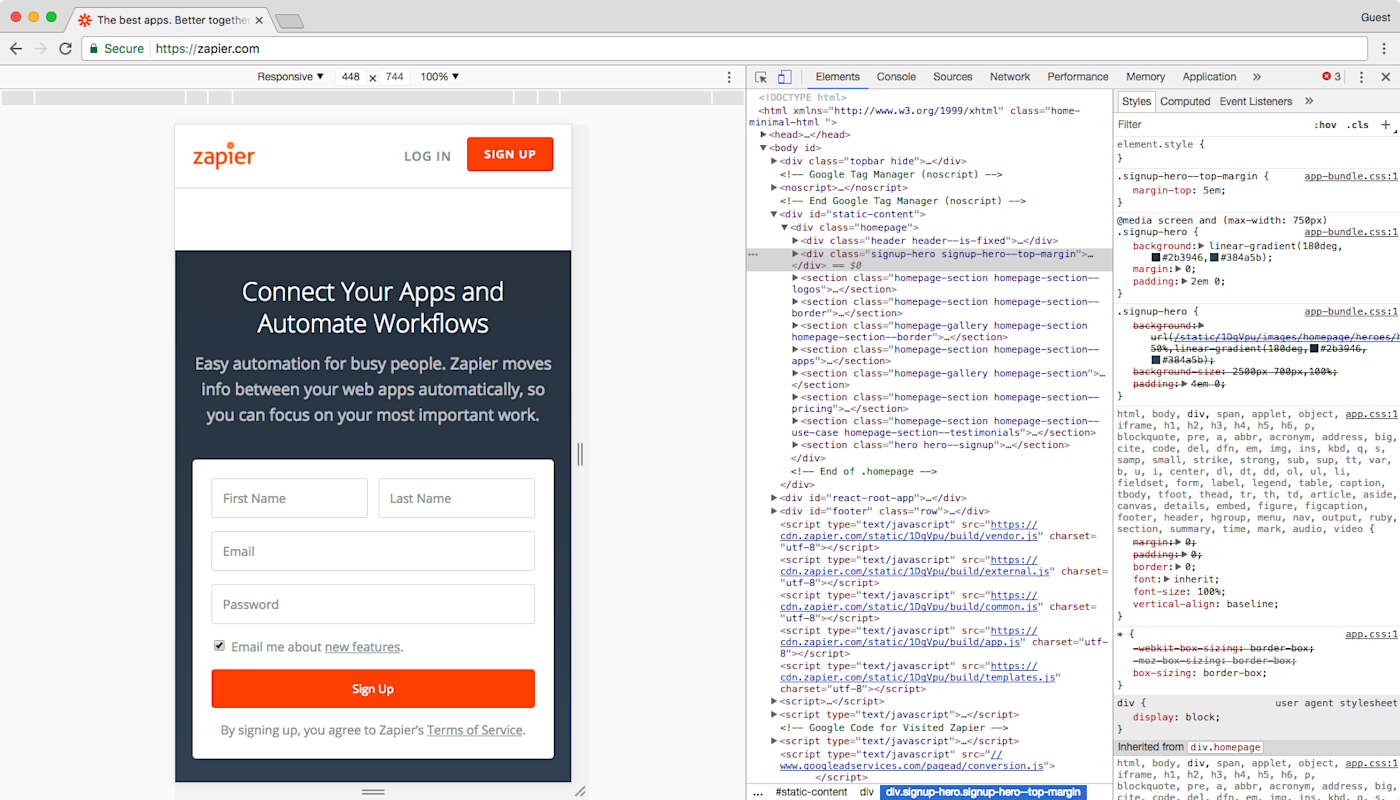
Resize the small browser to see how things wait if you were browsing on a tablet, phone, or even smaller screen. Or, click the menu at the top to select default device sizes like iPad Pro or iPhone 8 Plus—go ahead and select the latter.
The spider web page screen should shrink down to an iPhone 8 Plus' size, and yous can zoom in a bit past clicking the + icon next to the number at the summit correct of the filigree—that's how the site would look if someone zoomed in on mobile.
Get ahead overstate the view past dragging the correct edge of the spider web page emulation right. See what happens? Nosotros're no longer in the iPhone 8 Plus view. Dragging the screen along the grid allows you to meet how the web folio volition change every bit the screen size changes, but your view will no longer reflect the device model that you chose previously.
Let'south go back to the iPhone 8 Plus view by selecting this in the model drop-downward list once more. Next to the drop-down list is the word "Portrait." As y'all may have guessed, this allows you to toggle between the landscape and horizontal view.
At present, we can run across how this post would look if yous were reading information technology on an iPhone 8 Plus. Experience free to play around with the other devices to meet how this web page and the screen resolution changes. All of the other programmer tools that we accept gone over so far will too react to the device view. For case, select the text of Zapier'due south tagline again.
In the iPhone eight Plus view, we tin see that this text is 2em, while in the default view on a estimator, information technology'southward 3em.
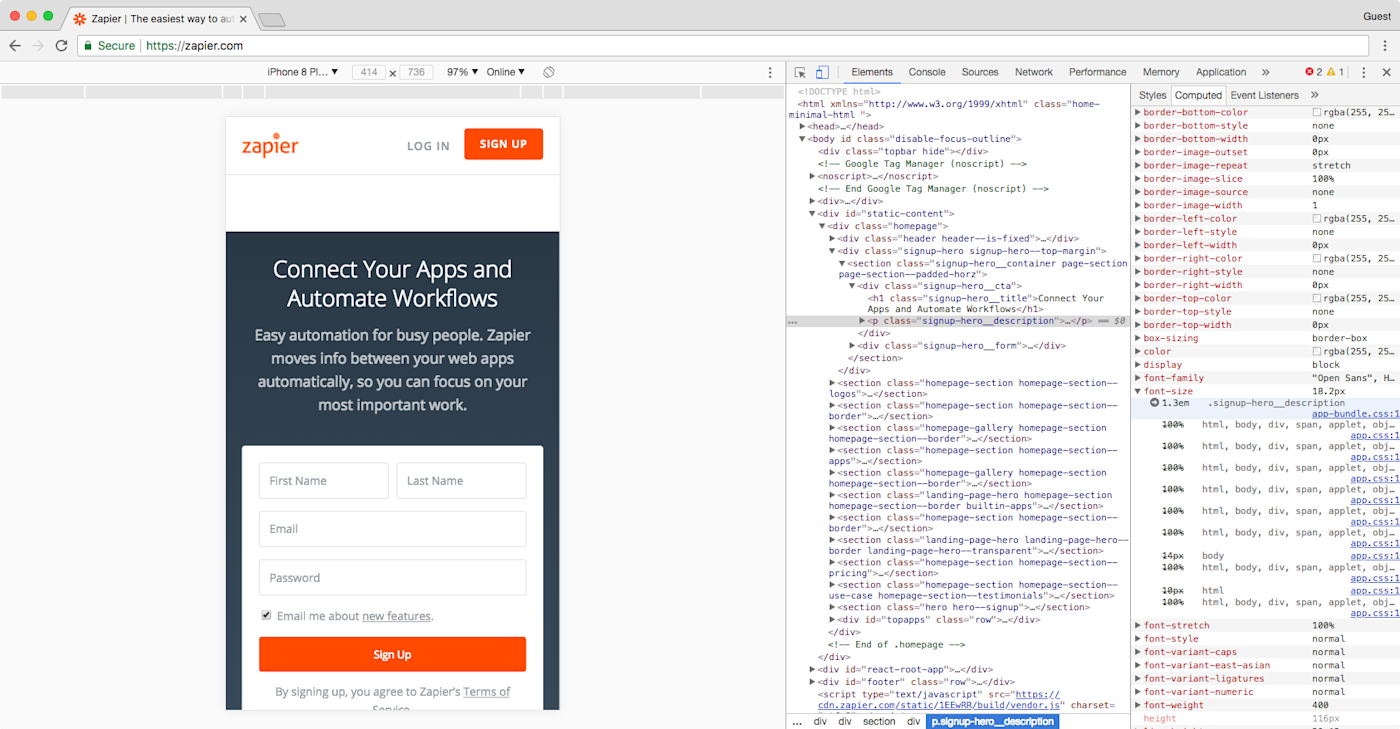
The "em" is a font-size unit that allows you to automatically modify the size of text relative to the surrounding text. For example, let's say we have a user with large custom font settings on their browser. If you lot set your paragraph font-size to 14px, your font will always exist 14px to that user no thing what. However, if you set your paragraph font-size to 1em, your user'south browser will use this unit to calibration your text to your user's large settings. Phones and tablets do this to zoom text nicely.
Now let'due south switch to the Apple iPad view and select the "testing across devices" header above. This time, the font-size is 3em. The font-size changed based on the device view, back to the default size it'd apply on a computer, cheers to the tablet'south larger screen.
Emulate Mobile Device Sensors
You may accept noticed that your mouse now appears equally a footling circle on the web page. This allows y'all to interact with the page as if you are on your mobile device. If yous click while dragging the page down, this does non highlight text similar it normally would in your browser—it drags the screen down like you are on a touchscreen device. Using this view, you can see how large bear on zones are on a web folio. This ways that y'all can run into which buttons, icons, links, or other elements are easily touchable with the finger.
Yous can fifty-fifty make your browser act like a phone. Press your "Esc" primal to open up the search pane in Inspect Chemical element again, and this time click the 3-dot menu on the left side for a card of options. Select Sensors to get three new tools: Geolocation, Orientation, and Touch.
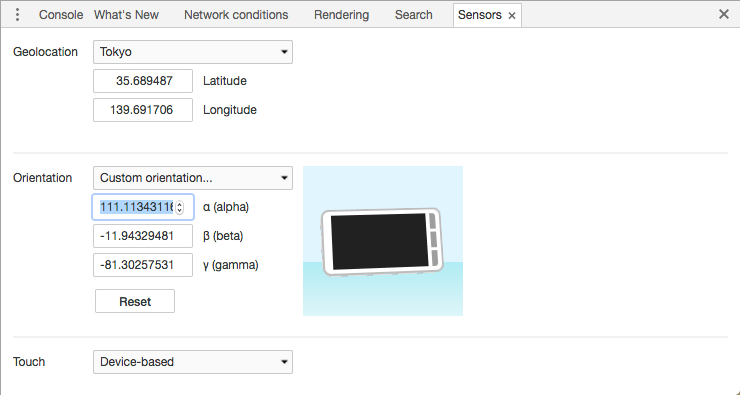
Touch lets you turn on or off the default circle selector that acts more than like a finger than a normal mouse cursor. Orientation lets y'all interact with movement-sensitive websites such equally online games that let you move things by moving your phone. And Geolocation lets you lot pretend you're in a unlike location.
Let's try viewing this site from Google'south Headquarters in Mount View, CA.
Cheque the box next to "Emulate geolocation coordinates," and enter the value 37 into the Lat = text field and 122 into the Lon= text field. Press enter on your keyboard.
Cypher changes, correct?
This is because there isn't content on this page that changes based on your location. If y'all change the coordinates on a site like Groupon.com that uses your location to show localized content, though, y'all would get different results. Go to Google.com in a dissimilar location, and you'll perhaps run into a new Google logo for a holiday in another country, or at least volition go the results in a different language.
Emulation is a smashing style to put yourself in your user'due south shoes and consider what the user may be seeing on your web page—and it's a fun way to explore the international web.
Emulate Mobile Networks
You can as well run across what it's like to browse a site on different networks, perhaps to see if your site will load even if your users are on a slower 3G network.
To give it a attempt, click the three circle push in the left of Inspect Element'southward search tab once again, and select "Network Conditions". There, y'all can cull from fast or slow 3G, or offline to run into how the folio works without cyberspace. Or, click Add... to include your ain testing (perhaps add 56Kbps to examination dialup internet). At present, reload the page, and you'll encounter just how long it'd take for the site to load on a ho-hum connection—and how the site looks while it's loading. That'll prove why you should improve your site to load faster on deadening connections.
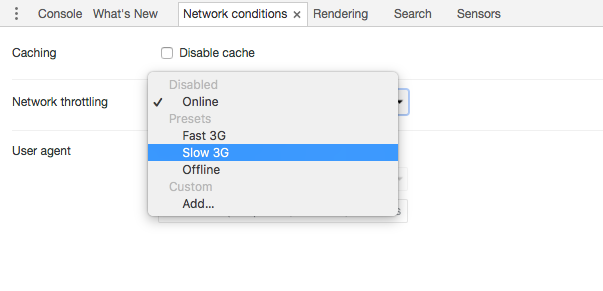
Y'all can as well change your user amanuensis—uncheck "Select automatically" abreast "User Amanuensis" and select "Internet Explorer 7" perhaps to encounter if the site changes its rendering for older browsers. That's too a handy hack to make webpages load even if they merits they only work in a dissimilar browser similar Net Explorer.
Challenges
Let'southward end with a few challenges. Go show us what you've learned!
-
Alter headlines on CNN.com and tweet us a screenshot of your trending commodity headline.
-
Duplicate your favorite web site using "View Source," and mess around with the HTML to make information technology your own.
-
See how your website renders on a mobile device, and bear witness your developer what could be done meliorate by fixing it yourself!
The Marketing squad at Zapier team relies on Audit Element to tweak private data out of screenshots in our app reviews, while our blueprint team uses information technology to mockup changes and see how things would look on various screens.
How do you lot use Inspect Chemical element? We'd love to hear your stories in the comments below!
This tutorial was originally published on January 5, 2015, then was updated and republished on June 6, 2017 and Jan 25, 2018 with screenshots and steps from the latest version of Google Chrome.
Get productivity tips delivered directly to your inbox
We'll email you ane-3 times per calendar week—and never share your information.

Inspect Element To Find Answers,
Source: https://zapier.com/blog/inspect-element-tutorial/
Posted by: sheldoncarror.blogspot.com
0 Response to "Inspect Element To Find Answers"
Post a Comment