

Is The Difference Between The Actual Fixed Overhead And The Budgeted Fixed Overhead.
10.eight Fixed Manufacturing Overhead Variance Analysis
Learning Objective
- Calculate and clarify stock-still manufacturing overhead variances.
Question: Many organizations as well analyze fixed manufacturing overhead variances. Recall from earlier chapters that manufacturing companies are required to assign fixed manufacturing overhead costs to products for fiscal reporting purposes (this is called absorption costing). It is common for companies such every bit Jerry'south Ice Foam to employ stock-still manufacturing overhead costs to products based on direct labor hours, machine hours, or some other activity. Companies using a standard costing system apply stock-still overhead based on a standard dollar amount per unit produced (this adding is shown in the footnote to Figure ten.12 "Fixed Manufacturing Overhead Information for Jerry's Ice Cream"). Assume Jerry's uses directly labor hours to assign fixed overhead costs to products shown in Figure ten.12 "Fixed Manufacturing Overhead Information for Jerry's Ice Cream". How is this information used to perform fixed overhead cost variance analysis?
Answer: It is of import to kickoff past noting that fixed overhead in the chief budget is the same as fixed overhead in the flexible budget considering, by definition, fixed costs do not modify with changes in units produced. Thus budgeted fixed overhead costs of $140,280 shown in Figure 10.12 "Stock-still Manufacturing Overhead Data for Jerry'southward Ice Foam" will remain the same fifty-fifty though Jerry'south actually produced 210,000 units instead of the principal upkeep expectation of 200,400 units.
Figure x.12 Fixed Manufacturing Overhead Information for Jerry's Ice Foam
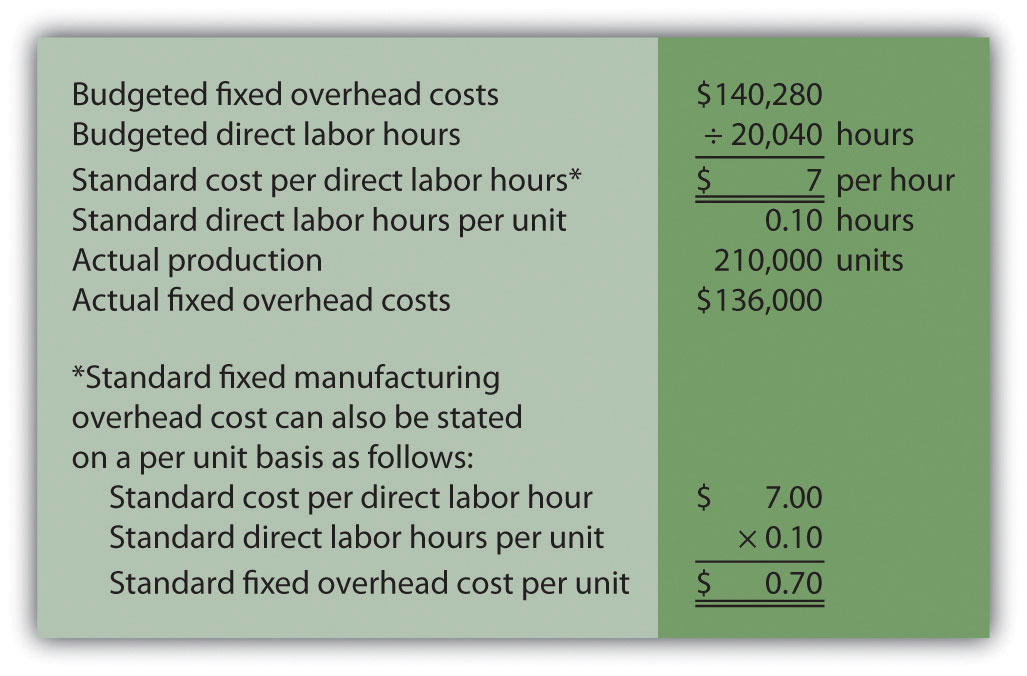
Fixed manufacturing overhead variance analysis involves two separate variances: the spending variance and the product volume variance. We show both variances in Figure 10.xiii "Fixed Manufacturing Overhead Variance Analysis for Jerry'due south Ice Foam", and provide farther item following the figure.
Effigy ten.13 Stock-still Manufacturing Overhead Variance Analysis for Jerry's Ice Cream
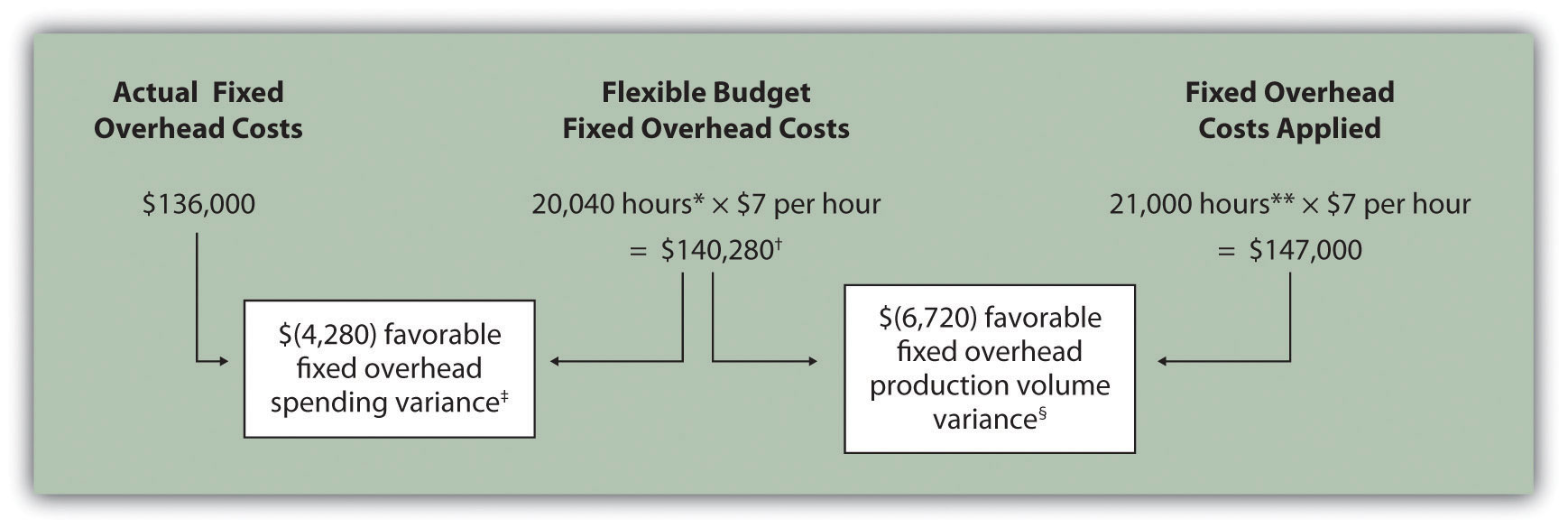
*From Affiliate ix "How Are Operating Budgets Created?", the direct labor budget is xx,040 budgeted straight labor hours = 200,400 units approaching to be produced × 0.ten direct labor hours per unit.
**Standard hours of 21,000 = 210,000 actual units produced and sold × Standard of 0.10 hours per unit.
† $140,280 is the original budget presented in the manufacturing overhead budget shown in Chapter 9 "How Are Operating Budgets Created?". The flexible budget corporeality for fixed overhead does not change with changes in production, and so this corporeality remains the same regardless of actual production.
‡ $(4,280) favorable fixed overhead spending variance = $136,000 – $140,280. Variance is favorable because the actual fixed overhead costs are lower than the budgeted costs.
§ $(half-dozen,720) favorable fixed overhead volume variance = $140,280 – $147,000. Variance is favorable because the volume of goods produced and sold was college than expected.
Fixed Overhead Spending Variance Calculation
Question: How is the fixed overhead spending variance calculated?
Reply: The fixed overhead spending varianceThe difference betwixt bodily and budgeted fixed overhead costs. is the difference betwixt actual and approaching stock-still overhead costs. As shown in Figure x.thirteen "Fixed Manufacturing Overhead Variance Analysis for Jerry's Ice Cream", Jerry'south Ice Cream incurred $136,000 in fixed overhead costs for the year. Budgeted fixed overhead costs totaled $140,280. Thus the spending variance is calculated as follows:
Central Equation
Fixed overhead spending variance = Bodily costs − Budgeted costs
Because fixed overhead costs are not typically driven past activeness, Jerry'due south cannot attribute any part of this variance to the efficient (or inefficient) use of labor. In fact, at that place is no efficiency variance for fixed overhead. Instead, Jerry's must review the detail of actual and budgeted costs to determine why the favorable variance occurred. For example, mill rent, supervisor salaries, or manufacturing plant insurance may take been lower than anticipated. Further investigation of detailed costs is necessary to determine the exact cause of the fixed overhead spending variance.
Stock-still Overhead Production Volume Variance Calculation
Question: How is the fixed overhead production volume variance calculated?
Respond: Before discussing the production volume variance, a word of caution: exercise not equate the stock-still overhead product volume variance with the variable overhead efficiency variance. There is no efficiency variance for fixed manufacturing overhead because, by definition, fixed costs exercise not change with changes in the action base. The stock-still overhead volume variance is solely a result of the divergence in approaching product and actual production. The fixed overhead production volume varianceThe deviation between the budgeted and applied fixed overhead costs. is the difference betwixt the approaching and applied fixed overhead costs. As shown in Effigy 10.xiii "Fixed Manufacturing Overhead Variance Analysis for Jerry's Ice Cream", Jerry's Ice Foam budgeted $140,280 in fixed overhead costs for the yr. Fixed overhead costs practical totaled $147,000. Thus the production volume variance is calculated as follows:
Key Equation
Fixed overhead production volume variance = Budgeted costs − Practical costs
The fixed overhead production book variance is a direct result of the difference in volume (units) between budgeted production and actual production. All other variables are held constant including standard direct labor hours per unit (0.10) and standard rate per direct labor hour ($seven). Thus an alternative approach to this calculation can exist used assuming the standard fixed overhead cost per unit is $0.70 (= 0.10 direct labor hours per unit × $7 per straight labor hour):
Key Equation
The fixed overhead production volume variance is favorable because the company produced and sold more units than anticipated.
Comparison of Fixed and Variable Overhead Variances
Question: What are the similarities and differences betwixt the fixed and variable overhead variances?
Respond: Figure 10.14 "Comparing of Variable and Fixed Manufacturing Overhead Variance Assay for Jerry's Ice Foam" summarizes the similarities and differences between variable and fixed overhead variances. Notice that the efficiency variance is not applicable to the fixed overhead variance analysis.
Key Takeaway
- Two variances are calculated and analyzed when evaluating fixed manufacturing overhead. The fixed overhead spending variance is the divergence between actual and budgeted fixed overhead costs. The fixed overhead production volume variance is the difference betwixt budgeted and applied fixed overhead costs. There is no efficiency variance for stock-still manufacturing overhead.
Review Problem 10.8
This review problem is based on the budget information presented in Chapter 9 "How Are Operating Budgets Created?" review bug and variance analysis information presented in Chapter 10 "How Exercise Managers Evaluate Performance Using Toll Variance Analysis?" review bug. The following information is for Ballad's Cookies:
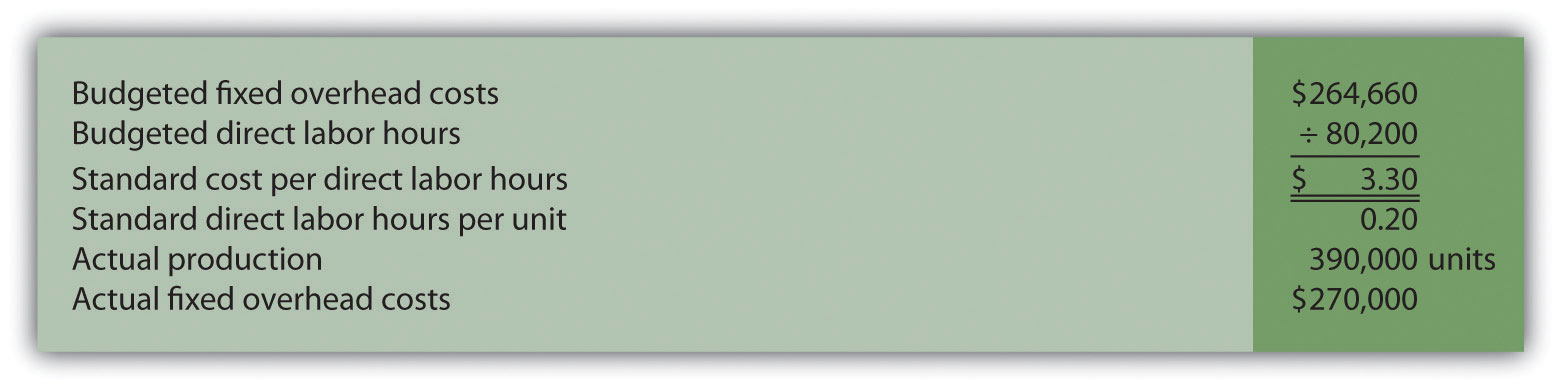
Calculate the fixed overhead spending and product volume variances using the format shown in Figure x.13 "Fixed Manufacturing Overhead Variance Analysis for Jerry'southward Water ice Cream".
Solution to Review Trouble 10.viii
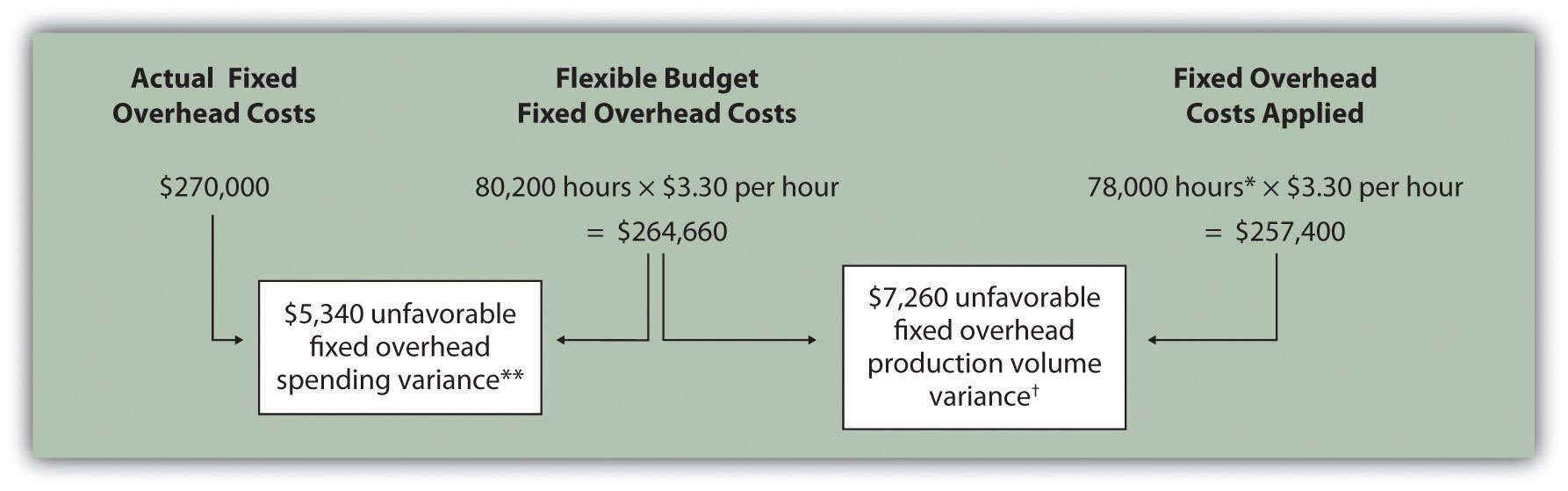
*Standard hours of 78,000 = 390,000 actual units produced and sold 10 standard of 0.20 hours per unit of measurement.
**$5,340 unfavorable fixed overhead spending variance = $270,000 – $264,660. Variance is unfavorable because the bodily stock-still overhead costs are higher than the approaching costs.
† $seven,260 unfavorable fixed overhead volume variance = $264,660 – $257,400. Variance is unfavorable because the volume of goods produced and sold was lower than expected.

Is The Difference Between The Actual Fixed Overhead And The Budgeted Fixed Overhead.,
Source: https://saylordotorg.github.io/text_managerial-accounting/s14-08-fixed-manufacturing-overhead-v.html
Posted by: sheldoncarror.blogspot.com
0 Response to "Is The Difference Between The Actual Fixed Overhead And The Budgeted Fixed Overhead."
Post a Comment