

What Might Allow An Allele To Become Fixed
BIOL2007 - INBREEDING AND NEUTRAL Development
Then FAR , we take dealt importantly with deterministic development, via natural option.
TODAY , nosotros explore the effects of finite population size and inbreeding on genetic variation, and show that this can lead to random evolutionary alter (or "migrate"). Mutation is, of form, a sort of random genetic change, but genetic drift tin work much faster.
 First we must report the theory of inbreeding, which can be "regular", for example in sib-sib mating such as the Pharaohs of Ancient Egypt, or every bit a simple effect of random mating in small populations. Nosotros first report regular systems of inbreeding , and so get on to how small population sizes can cause both genetic drift and inbreeding.
MEASURING INBREEDING
If an individual mates with a relative (or with itself! equally in some plants or snails), the offspring may be homozygous for a copy of an allele which is identical by descent from 1 of the ancestors:
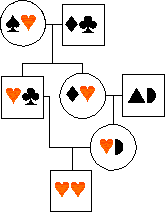
... in the diagram, a male is homozygous for 2 copies of an allele - - inherited from a unmarried copy in an antecedent. This is partly because his mum was also his dad'southward niece (a type of inbreeding that is common in many human societies).
The INBREEDING COEFFICIENT, F, is used to gauge the strength of inbreeding. F = probability that two alleles in an private are identical by descent ( IBD ). F stands for fixation index, because of the increase in homozygosity, or fixation, that results from inbreeding.
Annotation: two alleles that are identical past descent must be identical in land . However, a homozygote for an identifiable allele tin can often exist produced without inbreeding in its contempo ancestry. Thus identity in state does not necessarily imply identity by descent .
Is inbreeding always bad?
Inbreeding is not generally recommended because of the being of deleterious recessive alleles in nearly populations. Although these should exist rare per cistron (usually much less than 10-three, meet mutation-selection balance), there will be many deleterious alleles per genome. According to some estimates, you and I each carry about 1 strongly deleterious subconscious mutation. When homozygous, these mutations reduce fitness; inbreeding will therefore lead to inbreeding depression as the homozygous mutations become expressed.
However, inbreeding isn't all bad, and many organisms habitually inbreed. Animals such as fig wasps and certain parasites regularly mate with their siblings, and selfing is mutual in many of the well-nigh ambitious weeds of agriculture. The advantage is presumably ecological, since a single female can then colonize an empty resource or host. There may also be a genetic advantage by preventing recombination between adaptive loci. 1 assumes deleterious recessives in habitually inbreeding species have more often than not been purged past selection.
In human societies where some families have a lot of wealth, or where a bridal dowry is paid, inbreeding is common. Examples are European royal families, and on the Indian subcontinent. Perhaps here the idea is to prevent the "recombination" of wealth with other families!
In any case, mild inbreeding, such as mating between starting time cousins, or uncle-niece isn't so unsafe. Charles Darwin married his showtime cousin, Emma Wedgewood, and had an astonishing x children. Some were sickly or died young, but this was mutual in the days before penicillin.
REGULAR SYSTEMS OF INBREEDING
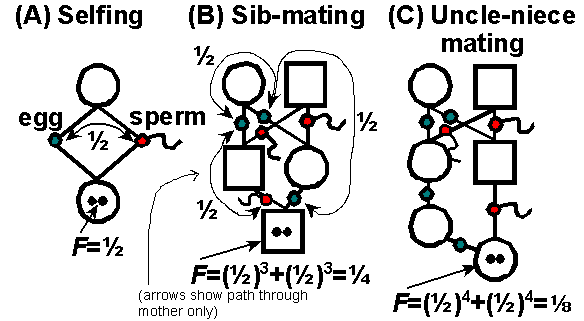
We can measure F easily in regular systems of inbreeding, using Sewall Wright'due south method of "path analysis":
i) Find each path that alleles may take to become IBD.Calculations similar these are used in genetic counselling, and in fauna breeding and in zoos to avoid inbreeding depression. Some examples:
ii) Notice the number of path segments ( ten ) between gametes (eggs or sperm) through a unmarried ancestor in common in each path.
3) Calculate the probability of IBD for each path. The probability that an allele is IBD betwixt 2 gametes connected through an individual is 1/2. Thus, the probability of IBD for each path is (ane/2) x .
4) Add together up the probabilities of each path to get the total probability of IBD.
 Upshot OF INBREEDING ON POPULATIONS
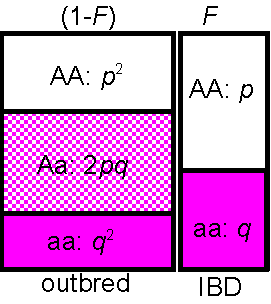
 Consider two alleles, A, and a with frequencies p,q with inbreeding (IBD) at rate F :
Frequency of homozygotes:
AA = (one-F)p 2 [outbred] + Fp [inbred]
= p 2 + Fp(1-p)
= p 2 + Fpq
Similarly the frequency of the other homozygotes, aa = q 2 + Fpq
All genotype frequencies must add to 1, then the actress twoFpq AA and aa homozygotes must accept come from the heterozygotes (which cannot be IBD, since they aren�t fifty-fifty identical in state), so overall, the frequencies are:
genotype AA Aa aa frequency p 2+Fpq twopq(1-F) q ii+Fpq Sum = one So, inbreeding leads to a reduction in heterozygosity within the population. The heterozygosity ( Het , i.eastward. the proportion that are heterozygotes under inbreeding) is reduced past a fraction F compared with the outbred (Hardy-Weinberg) expectation HetHW = iipq: Het = HetHW (ane - F)Therefore, every bit well as measuring a probability (of IBD), F besides measures reduction of heterozygosity, or heterozygote deficit compared to Hardy-Weinberg. The heterozygote arrears = the level of inbreeding (in the absenteeism of selection, assortative mating, migration, etc.).
GENETIC DRIFT
Deterministic vs. stochastic evolution
The Hardy-Weinberg police is the ground of all population genetics theory, but it assumes that in the absence of selection or other evolutionary forces, absolutely no gene frequency alter occurs during reproduction. This would be true in an infinitely large population; under these conditions, selection would be completely anticipated and deterministic .
However, this is merely approximately true in real populations of finite size. Assume a diploid population of constant size Due north . Each of 2N alleles are copied into gametes, which unite to form the next generation. Fifty-fifty if the alleles are equal in fitness (neutral), some will not reproduce, while others volition manage to transmit several copies to the next generation.
Below is an example of migrate. Imagine a rare species kept in a zoo with a population of only six diploid individuals. In that location are a total of 12 alleles (numbered ane-12 in generation 0). All alleles are causeless equally fit, and so that evolution is neutral. The alleles may as well be genetically distinguishable, or "unlike in state" (represented by colours).
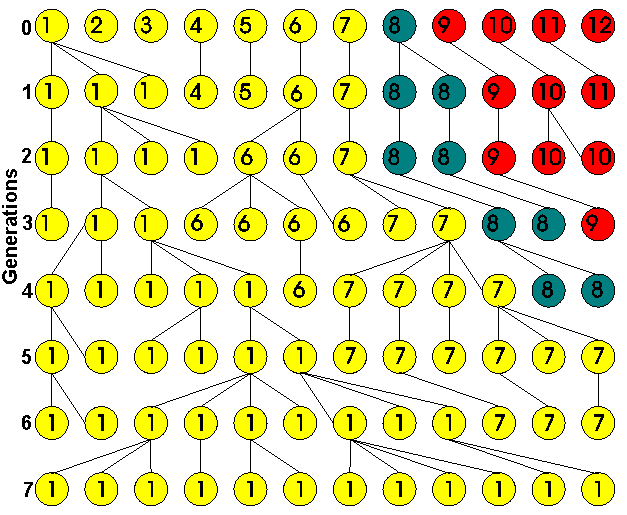
If the wild source population were large, all the alleles in generation 0 would accept come up from different ancestors; none would be identical by descent (IBD) . However, by adventure some alleles are lost in each generation. Afterwards a moderate number of generations, every allele will ultimately become a copy of just one of the original alleles, or IBD . In the diagram, all the alleles happen to get IBD to allele one by the 7th generation. Some other mode of saying this is that, looking backwards in fourth dimension, the coalescence time of the alleles in the final population is 7 generations agone.
Alleles that are IBD must besides be identical in state (barring mutation). Because the population has become stock-still for allele i, information technology has besides become fixed for the allelic state to which allele i belongs ("yellow"). Ordinarily, there are fewer allelic states than alleles, and then that fixation of state (gen. 5, to a higher place) tin can happen earlier than identity by descent (gen. 7). Random evolution in frequency of allelic states is called genetic drift .
This kind of evolution is non predictable; information technology is random or stochastic . Stochastic evolution occurs in any finite population, whether or not selection is operating - no evolution is completely deterministic . Even in large populations, evolution is simply approximately deterministic.
Drift is slower in larger populations. Why? If I tossed a money twice, and get 2 heads, you would not be surprised. If I tossed 20 times, and got twenty heads y'all would be very surprised. If I scored 200 heads in equally many tosses, you would rightly doubtable me of cheating. Similarly, if we accept two alleles in a population (equivalent to heads and tails), we become a larger variance of allele frequency if we have a modest population. This is equivalent to getting a more variable fraction of heads when tossing a coin a small number of times.
Predictable unpredictability (remember, science = authentic prediction!)
We tin't predict exactly what is going to happen in genetic drift, but the distribution of results is known, and useful. We can quantify the following:
i) The mean gene frequency . The probabilities for two alleles in a single generation are given by the binomial distribution, with binomial probability p and numbers of trials northward. The mean, or expected frequency in the future is simply the binomial probability p (similarly, the average fraction of heads is 0.5; the same every bit the probability of a single head on each throw).
ii) The variance of gene frequency after ane generation. The binomial variance is:
The standard difference ( SD ) of allele frequency is a good measure out of the speed of genetic migrate (remember, the mean stays the aforementioned). The SD is the square root of the variance; here, if N is the population size of a diploid population, then the full number of alleles, ( north in the binomial formula), is 2North , and then the standard divergence of allele frequency after i generation is: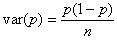
So supposing we are interested in the charge per unit of drift of the yellowish allele which has initial frequency 0.583 in the diagram above. In a population with twoN = 12 alleles, the SD of allele frequency in a single generation will be 0.142; this contrasts with 0.049 for 2N = 100, and 0.016 for 2North = 1000. The 95% confidence limits of the gene frequency after a single throw can exist calculated approximately, given that the binomial has an approximately normal distribution, as +/- 2 S.D.south from the mean.
Knowing the variance for a single generation, we can predict the long-term consequences of drift, including the probability distribution for allele frequency after a given number of generations. (The maths is, unfortunately, beyond this form!).
3) The probability that a item allele will eventually be fixed . Nosotros know that one of the alleles volition somewhen take over; the probability that it will be any particular allele is simply the fraction that the allele has in the population initially, or .
.
four) Eventually, any population volition become fixed for ane of the original alleles, and we can also predict approximately how long this will take. Looking backwards, this is the coalescence time of a given population. The coalescence time is given by (charge per unit of fixation)-1 (run across below) and will therefore be about 2Due north generations.
 EXAMPLES OF GENETIC DRIFT
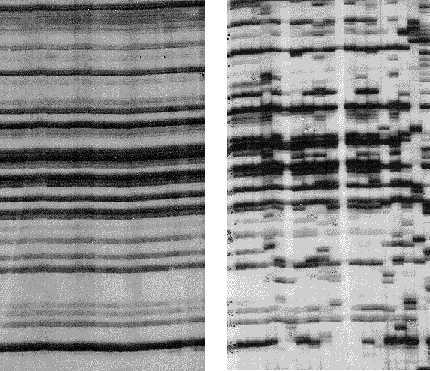
 Genetic drift is important in nature. Hither is a contempo instance from an Asian bramble (Rubus alceifolius) which is an introduced weed on some Pacific islands. Genetic variation was studied by ways of a Deoxyribonucleic acid fingerprint technique called "Amplified Fragment Length Polymorphisms" - AFLP for short. Each vertical "lane" on the gel represents Dna from a unmarried private; each AFLP band is thought to represent an independent DNA fragment, and polymorphisms are revealed by presence or absence of bands. In its native range (Vietnam, right), this species is highly polymorphic, while in an introduced population (the island of Réunion, left), no polymorphisms are observed. This suggests that the founder population was very modest, and that all variation has been lost. (meet Amsellem 50 et al. 2000.Mol. Ecol. 9: 443-455, reproduced past permission).
GENETIC DRIFT AS A Crusade OF INBREEDING
Equally we have seen, inbreeding results from migrate because alleles become identical past descent (IBD). We can therefore measure out drift in terms of our inbreeding coefficient, F :
In a population of size N , the probability that two alleles picked during random mating in generation t are IBD due to copying from generation t - 1 is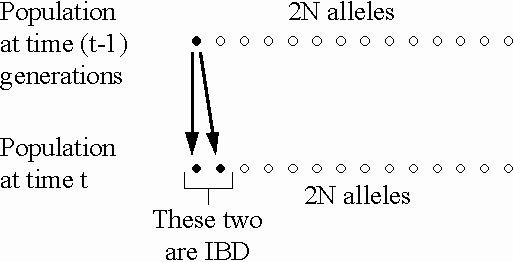
 (on average). This is the rate of inbreeding due to drift per generation.
 But the iiN alleles in the previous generation may be IBD themselves from inbreeding in previous generations. The fraction of alleles in generation t that are IBD because of inbreeding before generation t - 1 is:
Summing the inbreeding from previous generations together with inbreeding leading to the current generation at time t , we have: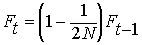
By definition, the heterozygosity after a single generation of inbreeding, Het = HetHW (i - F). (See to a higher place under Event OF INBREEDING ON POPULATIONS ). From the above equation relating Ft to Ft - 1 , and cancelling the HetHW (HetHW = 2pq remains the same betwixt generations, because the expected gene frequency p remains the same, but the actual Het volition change):

rearranging ...
therefore, subsequently t generations of drift: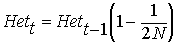
Thus, heterozygosity declines approximately by a factor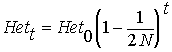
per generation. However, ... (a) This is truthful only on boilerplate because a single allele may have zip, ane, two or more than copies in the next generation. The cistron
is an average for each allele. (b) F can also mensurate inbreeding every bit a result of subdivision into ii or more finite populations. Remember that when we assumed Hardy-Weinberg, nosotros also assumed a lack of migration (i.e. mixing of populations).
When we sample from a number of sub-populations with different factor frequencies which exercise non mate randomly with each other, the heterozygote arrears gives us a measure of identity by descent produced past the population subdivision.
This betwixt-population inbreeding is ordinarily written FST , meaning inbreeding ( F ) due to subdivision into S ubpopulations relative to the T otal population.
For example, assume many populations of finite size Due north first from from the aforementioned gene frequency and drift apart for t generations. Inside each randomly mating population there is no heterozygote deficit, of course, merely each population is accumulating identity by descent at a rate of per generation (on boilerplate). Betwixt populations , this results in an increasing heterozygote deficit, or deviation from Hardy-Weinberg. This heterozygote deficit is measured by F ST . If all populations are of size N , the FST should be equal to the level of identity past descent or inbreeding , F , produced on average by drift within each population relative to the initial source population. Not bad, eh?!
You can try some simulations of migrate yourself; get to natural pick and drift simulations. You can utilise some of these (DRIFT.EXE, and PDRIFT.EXE) to get an estimate of the level of inbreeding and heterozygote deficit ( F or FST ) accumulated during genetic drift of upwards to 100 populations.
FST is widely used to study gene frequency variation over a geographic range as a measure out of population subdivision. This topic, which nosotros can't cover hither (shame!), is often referred to as population structure .
EFFECTIVE POPULATION SIZE
Even with no deterministic bias, or natural selection, alleles ordinarily do non have identical probability of beingness passed on, equally required in these simple models. Population geneticists get effectually this by calculating an idealized, or effective population size that produces approximately the aforementioned charge per unit of genetic drift in their unproblematic models equally does the actual population with all its complexity. The constructive population size may be rather different from the bodily population size. Ii examples:
1) Separate sexes. The elementary theory higher up assumes that a single individual may have two alleles IBD for a single allele in the previous generation. In fact, they tin can just do this if there is selfing. In dioecious organisms similar united states, this is not (nevertheless!) possible. Separate sexes therefore enforce some outbreeding, and slow the buildup of identity past descent: the constructive size is marginally larger than the bodily population size.two) Diff sex ratio. In species which maintain harems, like the elephant seal (see afterwards in Sexual activity AND SEXUAL Pick ), a single male may commandeer almost all the matings by fighting off other males. Similarly, in modern cow herds almost all females are fertilized artificially; a unmarried bull provides enough sperm for thousands of offspring. Although there are millions of cows in Britain, calves are mostly progeny of very few bulls. The constructive population size may therefore exist in the hundreds rather than millions, because genes in the population are funnelled through these few bulls in every generation.
FINALE
During this lecture, we measured inbreeding using the inbreeding coefficient , F . We practical this method to regular systems of inbreeding , so tried something a flake trickier: to apply F to mensurate inbreeding due to genetic drift in finite populations.
The Hardy-Weinberg law is very useful, and simple models of natural selection work well almost of the fourth dimension. Nonetheless, these models have the e'er-and then-slight drawback that they depend on an assumption of infinite population sizes. Before today, nosotros modeled evolution in terms of infinitely divisible gene frequencies. In fact this is only doesn't work: some of the most interesting development happens when nosotros mix random genetic migrate -- due to finite population sizes -- with deterministic forces -- selection. Drift may or, may not be important in evolution, but it always happens, because populations are ever finite.
For now, it is worth knowing that the equation characterizes possibly the nigh important genetic problem in conservation. The equation will exist important in any species with low overall Due north ; for example in many endangered large mammals, such as tigers in the Gir forest in India, Florida panthers, and Sumatran rhinos.
Well! That's probably enough for today!
FURTHER READING
FUTUYMA, DJ 1998. Evolutionary Biology. Chapter 11 (pp. 297-314).
Population Structure lecture notes (optional!).
Back to BIOL 2007 TIMETABLE

What Might Allow An Allele To Become Fixed,
Source: https://www.ucl.ac.uk/~ucbhdjm/courses/b242/InbrDrift/InbrDrift.html
Posted by: sheldoncarror.blogspot.com
0 Response to "What Might Allow An Allele To Become Fixed"
Post a Comment