

Who To Call To Fix Cracks In Walls
I accept over twenty years of experience painting, including getting rid of old, cracked pigment and making walls look like new. Here's how I do it.
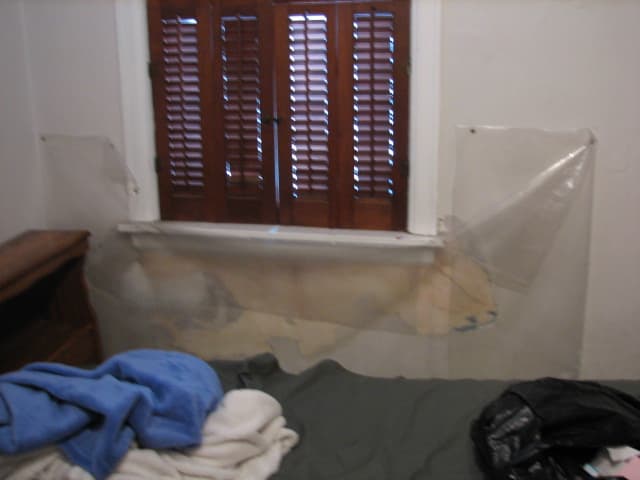
Under this window, moisture damage ruined the paint and some of the plaster.
Cracked Paint
Many older homes accept been painted so many times that the paint becomes a series of thick layers. Humidity, wet, and time take a style of causing these layers to divide and bubble, somewhen leading to groovy and chipping. When this happens, removing the loose paint is a must, but the paint removal will leave the walls uneven. To restore your walls to a smoothen, even surface, the damaged areas must exist reworked.
This work is not hard, and the price to do the job is minimal. When you lot practice the repairs, it will add a professional quality to your finished walls, and you lot volition experience adept about the work invested.
How to Remove Old, Cracked Paint
- The first will be to clean out all the old, damaged paint and plaster that has come loose.
- The 2d step is to resurface the damaged area. I call this floating the wall or ceiling. This sometimes requires several applications of sheetrock compound which I will refer to as MUD.
- The last stride will be to sand to a finish and apply a couple of coats of primer/sealer.
The concluding outcome volition depend on the corporeality of care put into a relatively piece of cake job. The problem comes with having the patience to take your time and do a good task of it. Read on for detailed descriptions of each of these steps.
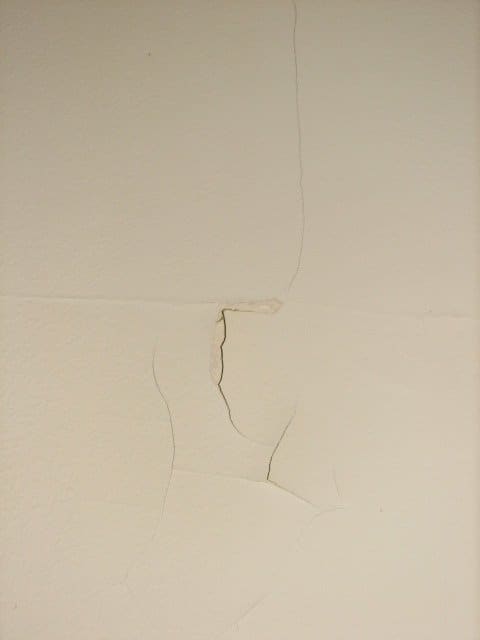
Time to Fix Things Up!
What You Will Need
- vi-in-i tool
- mud knife or straight-edged trowel
- mixing bowl
- spatula
- sheetrock articulation compound (this tin can be bought already mixed in pocket-size to large buckets or bags or you can purchase dry joint chemical compound and mix it yourself)
- sanding block
- sandpaper
- shop vacuum
What About That Joint Chemical compound?
I like to purchase it in dry out form for ii reasons. The first is that you mix only what you need and the remainder will last a long time equally long as you do not get it wet. The 2d reason I would rather mix my own mud is that I can vary the consistency of the moisture mud to apply the product for dissimilar forms of application.
The dry compound also comes in dissimilar drying times. You tin purchase a quick gear up that will brainstorm to stiffen in as little every bit 20 minutes, or you can get a slow prepare that takes an hour to stiffen. I generally use the quickest set considering I am usually in a hurry doing repairs. The slower-setting compound is best to use when you are working on larger areas.
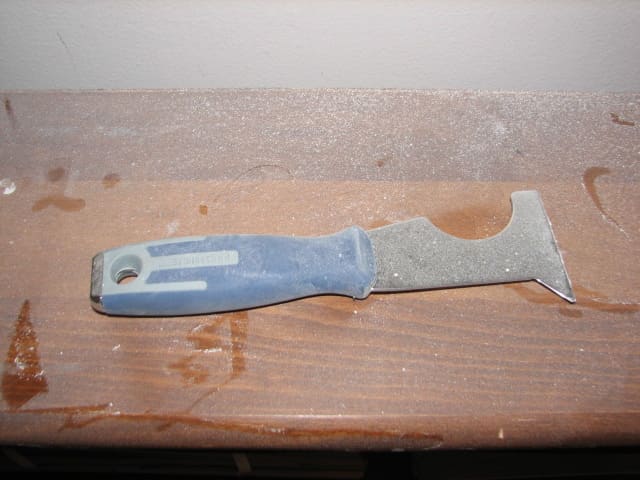
6 in One Tool.
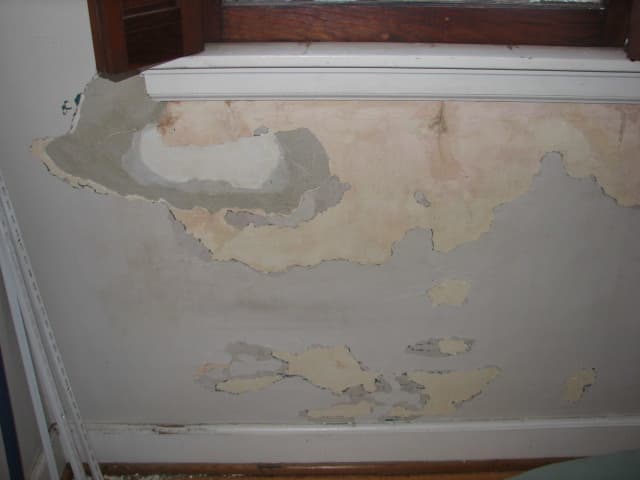
Cleaned and scraped: ready for repair.
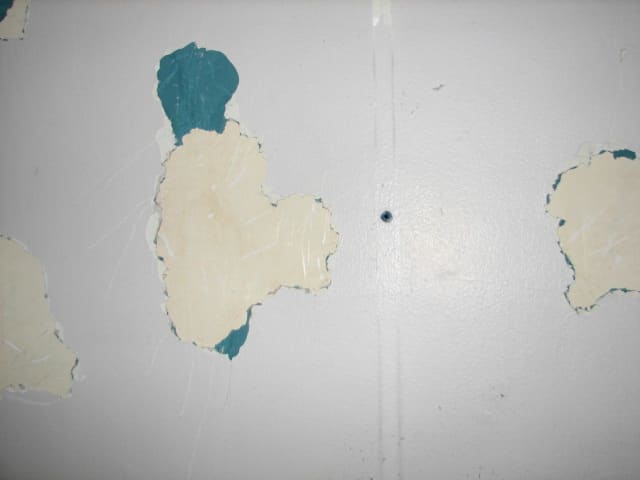
Years of layered paint.
Step 1: Remove Loose Pigment and Debris
The first thing you have to do is go rid of all the loose paint and debris that is peeling from the wall or ceiling. I similar the handy "vi in ane tool" for this job. It has a couple of dissimilar edges on it that you tin can apply to gouge, score, and scrape with. That is the perfect tool for opening up the bubbles and cracks.
You can utilise the apartment edge to scrape away the loose pigment and sometimes part of the plaster or sheetrock. And so you tin can apply the pointed edge to pick in tight spots and gouge out small-scale loose areas. This tool is too keen when you come up to old caulk considering you lot can dig in and under with information technology and it takes care of about everything you need to become removed. I unremarkably take a grinder and employ it to keep my "6 in i" very sharp. It makes the work get faster if the edges are honed down to a precipitous blade.
Scroll to Go along
Read More than From Dengarden
When I have everything cleaned out with the six in one, I take a sanding block and speed over everything to ensure that all loose areas are gone. This does not require serious sanding, so just speed through. Yous should so apply a damp cloth to wipe abroad grit. Now the expanse is prepare for repair.
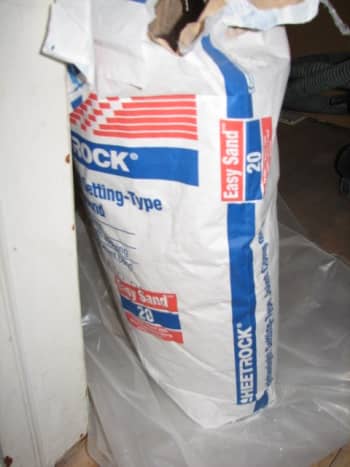
Pace 2: Refloat the Wall
Now that the bubbles and cracks in your pigment are opened upwards and scraped clean, information technology is time to refloat the wall. What that actually means is putting an even glaze of mud on the holes so that the wall is smooth and back to the original apartment surface. This is a little flake tedious, just I believe anyone can practise it if they take their time and are careful.
I wrote a little about the sheetrock joint compound to a higher place. I am using this because I like the mode it performs. There are other products that you tin can purchase for the same purpose but personally, I practise not like them as much as the sheetrock joint compound. You can use Plaster of Paris. There are other proper noun-make products on the market. I know I accept used everything they manufacture and I ever get back to the joint compound. I e'er use the powdered class that you take to mix yourself. I told you why but allow me expound.
- Powdered joint chemical compound volition keep for a long time, similar several years if you keep it dry. It is non similar the premixed saucepan product for a couple of reasons. They must put some kind of stabilizer in the premixed mud. It does not feel the aforementioned when you are working with information technology. Too, after the container is opened the product starts to dry out. Information technology beginning dries effectually the edges of the container that it comes in. No thing how hard you lot attempt to go along it covered it volition begin to dry the second it makes air contact. Nigh repairs of whatever size will require more than one awarding.
- Each time you lot open up the container you are exposing the premixed mud to the air. Virtually the third or fourth time y'all open up the container you showtime to get crusty, semi-stale pieces of the joint compound falling downwards off the edges of your container and correct into the good mud. Now when you are trying to carefully spread an even layer of the mud onto the wall and a hunk of the crusty stuff gets into the skillful mud, it drags a hole in your wet piece of work area. This will brand you crazy equally you will take to finish and choice out the picayune dry hunk and so try to refloat your work. It is just also annoying for me.
- The other affair virtually the premixed joint compound is that it is in a container that costs more to packet and you will pay ii or three or even four times equally much for the premix. Know what are you paying for besides convenience? The answer is h2o. That irks me likewise. So the fact is that you lot are better off purchasing the powdered chemical compound and mixing up what yous need.
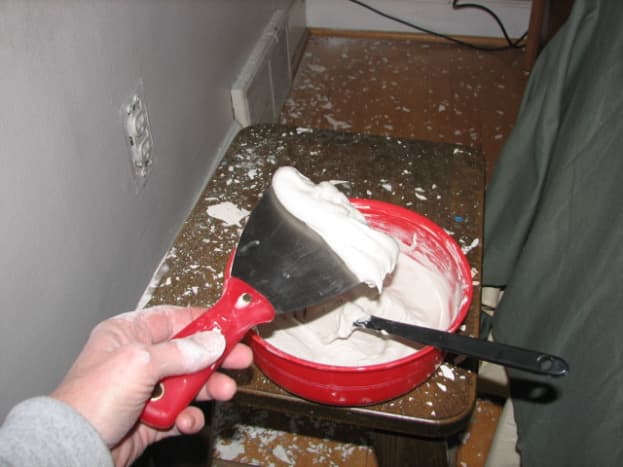
Step 3: Add together Sheetrock Mud to the Damaged Areas
At present that you have your compound mixed, yous tin start to float the new cease. The commencement application of mud will not practice the task. It normally takes two, 3, and sometimes four applications to get information technology correct. That is why I like the fast set formula. You can first in one area and utilize the first coat and motility on to other repair areas. By the time you have the entire first application in all the damaged spots, information technology might be dry plenty to get-go sanding. I always make sure to put the start glaze on sparse not more than ane/8 of an inch thick. This is a practiced way to proceed the sanding to a minimum.
I also like to employ a fan or portable heater to finish the drying toward the cease. This volition assistance ensure that you do not hit soft chemical compound. Pay close attention to the color of the sheetrock chemical compound you applied. Information technology will be grayness when it goes on but then it turns white as it dries. Soft spots that are not completely dry will not be ready to sand and they will still be grayness in the deepest areas. Make sure it has all turned white before yous sand. You tin can run into in the adjoining photo how the edges are starting to turn white. Brand sure to sentry for soft grey spots.
Sand with fine sandpaper on a sanding cake. Then mix more sheetrock chemical compound and add another sparse layer of the mud to make full deep areas and do the same as you did in the showtime step. Apply a sparse coat on everything and expect for information technology to dry. The sanding should only be done to the point where the new mud is level with the existing walls. Do non sand too deep. Run your hands over the areas you accept worked to experience for imperfections and as well visually inspect your work.
This repair required five applications of sheetrock compound to get it back to the same as the original wall. It becomes a smaller and smaller amount to fill as the layers of stale mud build to course your new wall surface. It is not actually hard work it just takes fourth dimension. Make sure to take adequate ventilation when you are doing this kind of work. You should always wearable a mask over your face to prevent as much inhalation of the sanded dust as possible. The better the quality of the mask the better for your health.
I ever vacuum in betwixt sanding to help go on the dust to a minimum. The less dust, the better. I get through store vacuums pretty regularly. The fine grit is hard on the motor of the vacuum and so you lot tin can imagine how difficult information technology tin can be on your lungs. It is smart to use the best filters for your vacuums likewise. The better ones cost a little more but the benefits for you and your machine outweigh the expense.
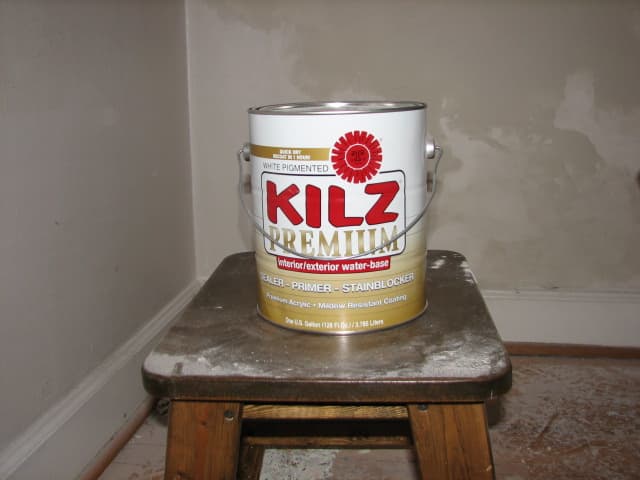
Kilz is my favorite sealer/primer.
Footstep four: Seal, Prime, and Paint
The wall should feel nice and polish and y'all should not be able to feel a difference in the level of the wall. If y'all experience a hump, you lot demand to sand down. If yous feel a dip, you lot need to make full it with another application of sheetrock compound. When you are satisfied with the style it feels and looks, y'all are ready to finish with a sealer/primer. I always use Kilz brand primer because information technology has always done me a good job and I have been using information technology for over 20 years. In that location are other primer/sealers on the market, but Kilz is my go-to production.
I always utilise two coats to the entire wall. The first coat volition seal the new repair and the second coat volition give y'all a squeamish even wall that is compatible in colour and prepare to paint. It is a good idea to wipe down the walls before yous apply the primer. I practice this with a dry out clean cloth and I also run a vacuum over the walls and everything around the work surface area. The less dust, the better the paint job. It is improve for your wellness besides.
So there you have it. This work can be achieved by anyone willing to take the time and effort and it will save you a bundle compared to hiring a professional person. Good luck on your repairs.
The finished product.
This commodity is accurate and truthful to the all-time of the author'due south knowledge. Content is for advisory or amusement purposes only and does not substitute for personal counsel or professional advice in business concern, financial, legal, or technical matters.
© 2009 C.South.Alexis
tawd on October 10, 2019:
Heyyy, and so my crackling pigment state of affairs resides on a brick wall, at least one layer under the top one, in the bathroom of my 1930's cottage.
Obviously I can't skim coat brick, and then I was wondering if you had whatever thoughts?
Cheers
Kat on September 10, 2018:
Pakistani repair/maintenance guys here in Dubai should learn this. Their work are below tolerable!
Kelly B. on Baronial 09, 2018:
I just wanted to tell you how incredibly helpful this article was! These old houses tin be bears to work with just knowing other people exercise it, makes me hopeful! Thank you!!!
NYC D on July 14, 2018:
How-do-you-do, does everything in the article in a higher place employ also to concrete / "plaster" walls? That's what we have--concrete aka plaster aka masonry walls. (At least I *think* all those phrases mean concrete. In any event, our walls are definitely non drywall/sheetrock.) So do any of the steps you listing NOT apply to our walls? In whatever issue, thanks for the bully write-up!
Traycee on March 25, 2018:
This is exactly my trouble. I noticed a small bubble on wall. I scraped information technology thinking it would be a small quarter size repair. It turned into a large area of paint that was loose. I am going to try to repair that department of the wall. Is the mud applied over the entire section where the paint came off OR just around the edges? Thank y'all
Lorenzp on March 17, 2018:
we call that tool a 5-in-1,non 6-in-ane
midori on December 26, 2017:
Thank you for taking the time to craft such a detailed explanation. Very helpful and much appreciated.
Sharon Whittington from Labarque Creek, MO 63069 on November 13, 2017:
Wow! Cool:)
PATRICIA on August 18, 2017:
VERY USEFUL AND PERFECTLY EXPLAINED! THANX!!!
Bishop55 on June 24, 2013:
Great hub! Voted upwards!
C.S.Alexis (author) from NW Indiana on October 20, 2011:
I accept no suggestion other than to practice some research so that you exercise not create unsafe piece of work weather. Better to have fourth dimension to find out than make a mistake.
Chris on October nineteen, 2011:
So what are y'all suggestions for fixing a wall that potentially has lead based paint?
philipandrews188 on Baronial 31, 2011:
Very very useful hub.
C.Due south.Alexis (author) from NW Indiana on November 18, 2010:
mommyofalot,
We had the aforementioned situation. The clammy wall on this project was beingness caused past water running off the roof. The gutters had to be repaired outside. It is best to notice the source of the dampness earlier doing the repair or it will come back on you.
The wall can be dried out subsequently the source has been repaired using a dehumidifier and a fan. This may accept a few days, but it is worth it to make sure there is no dampness before repairing your wall.
mommyofalot on November 18, 2010:
The wall in my bath looks alot like your wall originally did. And you did a WONDERFUL job fixing it< which motivated me (since you lot added footstep by stride instructions). The weird thing though is the pigment originally bubbled so I used a mud knife to scrape and removed the pigment and damaged parts off of the wall. At present that I'grand ready to prepare information technology the wall information technology clammy to the affect so I dont know what would cause that. When we moved in 3 years ago the house was inspected merely im wondering would wet walls be something that is checked for. Do you take whatever suggestions on what I tin exercise to dry the wall and go on information technology dry before I repair information technology.
C.S.Alexis (author) from NW Indiana on October 25, 2010:
agvulpes,
No damper at all. In fact i should have mention taking precations for a atomic number 82 based paint. Thanks for bringing it to my attention.
Peter from Australia on October 25, 2010:
Hello C.S. you sure know your stuff and I do not green-eyed anyone the task of repairing plaster walls. From the pictures in this Hub you have done a slap-up job.
One word of warning which should be spelled out in loud words is the fact that a lot of the old paint contained a very dangerous metal called 'atomic number 82' and if this is in the paint that is beingness sanding the results could be quite disastrous for the painter and and children that breathe in this dust! Modern paints these days practise not have 'lead' in them!
Sorry to put a damper on such a wonderful Hub !
Morris Streak from U.k. on May x, 2009:
I agree. Maintaining one's house can be a pain, especially when one doesn't have the patience to ready information technology. Good hub. You certainly know what yous're talking about. Plus, the photos document well the point you were getting beyond. In a a way, I'm into house repairs myself.
SuperiorInteriors from San Diego, California on March 17, 2009:
My Landlord has had the bath repaired improperly in the past and it was bailiwick to an most complete deterioration. After removing the old garbage, I relaized the whole basically went clear through to the houses exterior. Well patched that 1 upwardly and my side by side plan is to find a new landlord.
Good advice and very useful hub.
C.Southward.Alexis (author) from NW Indiana on February 12, 2009:
Samanta,
The thing to do is if you tin use the paint do not put it on the same wall as anything you lot have already painted with this color. If you tin can commencement a fresh wall with information technology and the remaining pigment is not total of lumps I say use information technology. The difference in color will not exist noticeable enough to matter because a different wall will exist picking up a dissimilar angle from the light. I would not use it for touch up on annihilation that you painted 2 months ago. More than likely information technology will not friction match.
Samanta on February 12, 2009:
Unfortunately a container with full of icidulux 3 in 1 wall paint remained open for 2 months. As a consequence a thick hard layer has formed. Can anybody suggest me whether I can use the rest pigment beneath the thick layer? Is there any reaction with air under such status? Whether the color will remain aforementioned or not?
SweetiePie from Southern California, U.s.a. on February 06, 2009:
Today I had to put in a new doorknob and spackle the cracks effectually the where the old knob had been. It is non exactly painting, just this hub was helpful because spackling needs to be done in layers just like painting.
C.South.Alexis (author) from NW Indiana on February 05, 2009:
Hoopskirtman,
I am blest to have a few skills then I try to make the most of them. Thanks for reading my hub.
HoopSkirtMan on Feb 04, 2009:
I envy yous ingenuity with being able to apply your skills that way to brand extra money. Practiced for yous!
C.S.Alexis (writer) from NW Indiana on February 04, 2009:
SweetiePie,
I accept most 30 years of feel, my life has revolved effectually a paintbrush and yes it does pay very expert for physical labor. Guess that could exist the next "How to start a business organisation" hub. My oldest son is a wedlock painter. He said he did not want to learn to paint and I told him he had to learn when he was 19 years former because, and then he would have a skill he could always fall back on for piece of work. I know because I practice it all the time.
Last month I did two modest jobs and the Art Studio Rent is paid up through June, It is a proficient skill to know. I accept made an extra $2100. this year, 2009, painting role time.
SweetiePie from Southern California, USA on February 03, 2009:
Just a thought, but accept you ever considered offer your services as painting peoples' houses? Some how I think people would pay some what good money to do this because many do not want to take the effort to pigment.
C.Due south.Alexis (author) from NW Indiana on February 03, 2009:
Thanks Zsuzsy! Yes the sanding is messy but when that is washed the worst is over, right?
Zsuzsy Bee from Ontario/Canada on February 02, 2009:
C.South. Great demonstration. I detest the sanding part with a passion
Super duper hub again
regards Zsuzsy
C.S.Alexis (writer) from NW Indiana on Feb 02, 2009:
SweetiePie,
Thanks for reading my latest. my photos were stuck in my camera for over a week. This is where I am going to put my fine art studio. So far then practiced. But idea I would write the hub equally I worked on the place. I actually wrote the hub before I started working because I knew what I had to do. My nails look like the croaky pigment and no time for smooth,LOL. I go along hoping to get moved in and then something else comes up. The weather has been a big, slow me down, gene and, they are calling for 5 to eight" past tomorrow dark. Gauge God and Mother Nature have their feet on my tail huh?
SweetiePie from Southern California, USA on February 02, 2009:
Wonderful hub! I love to paint and the description of the cracked paint reminds me of my nail polish. It looks skillful for the showtime two days, then I add a layer considering information technology begins to cleft. Two more days information technology lasts, just by the fourth or fifth day it is time to start over again. Overnice demonstration with photos by the manner.
C.Southward.Alexis (author) from NW Indiana on Feb 02, 2009:
Wow BK,
1851 is actually an sometime i. I would try to set up it upwardly if the foundation is good. There is a lot of labor that tin can go in to renovations simply it is worth it especially if yous love the old stuff. I sure do. Thanks for sharing and reading my hub. C.S.
BkCreative from Brooklyn, New York City on February 02, 2009:
This is timely! My building was congenital in 1851 and frankly I had decided to give up. Merely now with a lilliputian guidance I may tackle some of what remains standing.
Cheers!
C.S.Alexis (author) from NW Indiana on February 02, 2009:
hot dorkage,
Yes information technology tin if y'all let it. I just think of it as some other work of art and it usually comes out pretty good. Thanks for commenting!
hot dorkage from Oregon, U.s.a. on February 02, 2009:
very useful. Mudding upward a wall drives me nuts!

Who To Call To Fix Cracks In Walls,
Source: https://dengarden.com/home-improvement/How-To-Repair-Walls-With-Many-Layers-Of-Uneven-Paint-Before-Repainting
Posted by: sheldoncarror.blogspot.com
0 Response to "Who To Call To Fix Cracks In Walls"
Post a Comment